7 Common ITR Filing Mistakes That Can Lead to Tax Problems in 2026
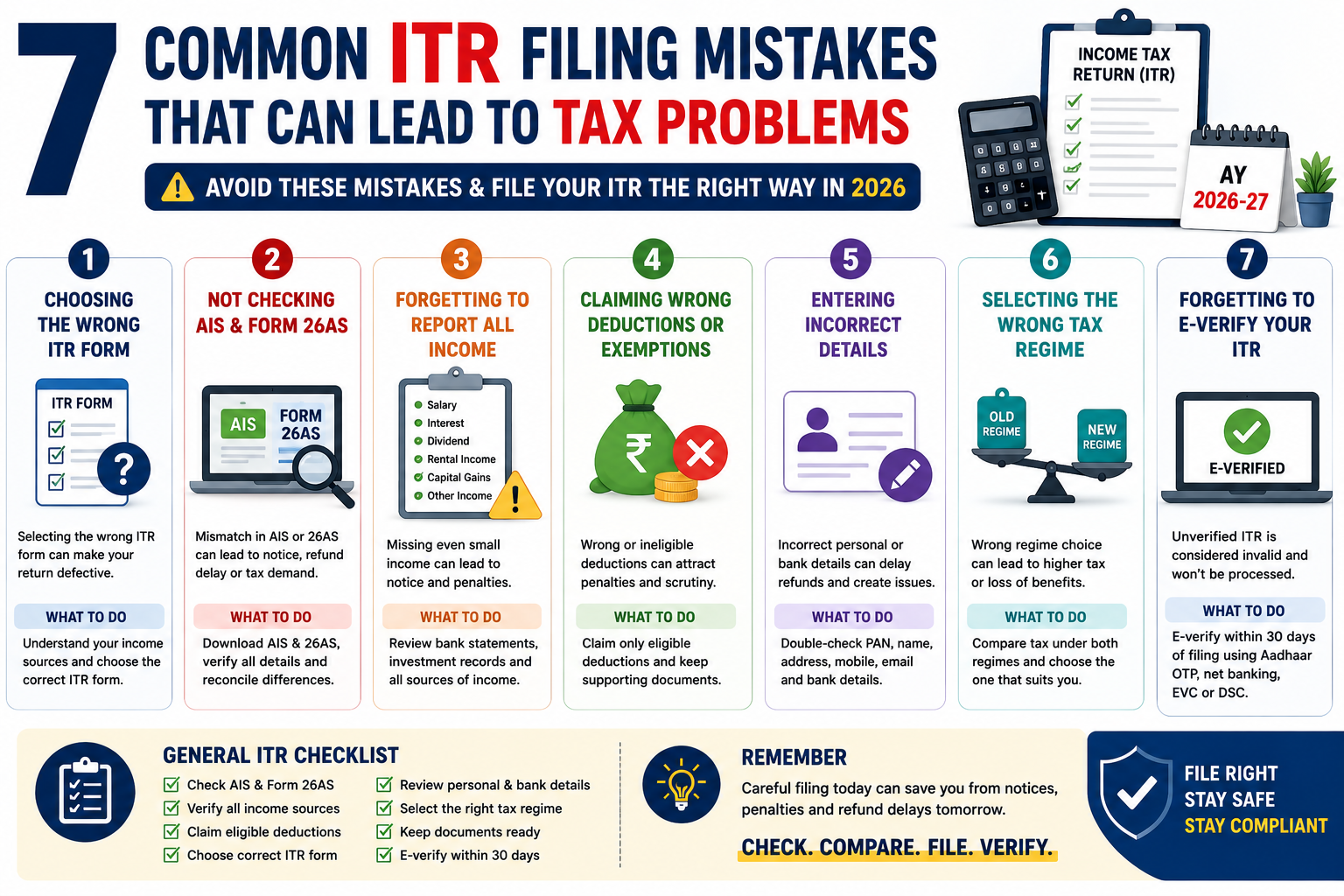
7 Common ITR Filing Mistakes That Can Lead to Tax Problems in 2026
Filing your Income Tax Return may look simple.
You log in, check the pre-filled information, enter your income, claim deductions, submit the return and wait for your refund.
But small mistakes can create unnecessary problems.
A wrong ITR form, forgotten bank interest, incorrect TDS information or failure to verify your return can lead to a defective return, delayed processing, additional tax liability or other complications.
The Income Tax Department itself advises taxpayers to check their tax regime, AIS, Form 26AS, documents, personal details and correct ITR form, and to file and verify the return within the applicable timeline.
If you’re filing your ITR for AY 2026–27, here’s what you should check before clicking that final Submit button.
1. Choosing the Wrong ITR Form
This is one of the most important mistakes to avoid.
There isn’t one ITR form that works for everyone.
The correct form depends on factors such as:
- Your income sources
- Residential status
- Business or professional income
- Capital gains
- House property
- Foreign assets or income
- Other applicable conditions
For example, an eligible salaried person with relatively simple income may be able to use ITR-1.
But if that same person has certain capital gains or other circumstances that make ITR-1 unavailable, another form may be required.
Similarly, people with business or professional income may need to consider ITR-3 or ITR-4, depending on their circumstances.
The Income Tax Department specifically advises taxpayers to identify the correct ITR form before filing.
How to avoid this mistake
Don’t choose your ITR form based on what your friend, colleague or family member used.
Instead, check your complete income situation.
The Income Tax Department also provides a “Help me decide which ITR form to file” facility.
2. Not Checking AIS and Form 26AS
Another common mistake is assuming that the information in your ITR automatically contains everything you need.
Before filing, you should review your Annual Information Statement (AIS) and Form 26AS.
They serve different purposes.
AIS
AIS provides broader information reported to the Income Tax Department, including various financial and tax-related transactions.
Form 26AS
Form 26AS is particularly useful for checking TDS/TCS-related information.
The Income Tax Department specifically recommends downloading AIS and Form 26AS and checking the actual TDS, TCS and tax paid before filing. If you find discrepancies, the department advises reconciling them with the employer, tax deductor or bank, as applicable.
Why does this matter?
Imagine your employer deducted ₹80,000 as TDS.
But the tax credit reflected in your records doesn’t match what you expected.
If you don’t notice the difference before filing, you may face unnecessary questions or processing issues later.
How to avoid this mistake
Before filing:
AIS → Form 26AS → Form 16 → Bank records → ITR
Compare the information rather than blindly copying numbers.
3. Forgetting to Report Additional Income
Your salary isn’t necessarily your only source of taxable income.
Many taxpayers forget smaller sources of income because they don’t receive a traditional salary statement for them.
For example:
- Savings account interest
- Fixed deposit interest
- Dividend income
- Rental income
- Freelancing income
- Capital gains
- Other taxable receipts
A ₹5,000 or ₹10,000 amount may seem insignificant, but you shouldn’t ignore income simply because the amount is small.
The Income Tax Department advises taxpayers to carefully study documents such as bank statements, interest certificates, Form 16, Form 26AS and investment records while preparing their ITR.
Example
Suppose you earn:
Salary: ₹8,00,000
Savings interest: ₹8,000
FD interest: ₹22,000
Your salary may be automatically reflected in your tax records, but that doesn’t mean you should forget the interest income.
How to avoid this mistake
Review your:
- Bank statements
- FD certificates
- Investment statements
- Dividend records
- Freelance invoices
- Capital-gains statements
before filing.
4. Claiming the Wrong Deduction or Tax Benefit
Tax deductions can reduce your taxable income, but you should claim only deductions you’re actually eligible for.
A common mistake is entering deductions simply because they were claimed in a previous year.
Your financial situation can change.
For example, you may no longer have the same insurance policy, investment, tuition payment or other eligible expense.
The Income Tax Department advises taxpayers to keep relevant documents and receipts for deductions they claim.
Common areas taxpayers may need to verify include:
- Eligible insurance payments
- Eligible investments
- Health insurance
- Education-related payments
- Eligible donations
- Rent-related claims, where applicable
- Home-loan-related information
Important
Don’t create or modify documents just to claim a deduction.
Keep genuine records supporting the information you report.
You generally don’t attach supporting documents to an ITR, but the Income Tax Department advises taxpayers to retain them for situations where they may later be required.
5. Entering Incorrect Personal or Bank Details
This mistake sounds basic, but it can cause unnecessary problems.
Before submitting your ITR, carefully check:
- PAN
- Name
- Address
- Mobile number
- Email address
- Bank account details
- IFSC, where applicable
- Other pre-filled information
The Income Tax Department specifically advises taxpayers to ensure details such as PAN, address, contact information and bank account information are correct.
Why are bank details important?
If you’re expecting an income-tax refund, incorrect bank information can delay the process.
The Income Tax Department also advises taxpayers to pre-validate the bank account where they want their refund credited.
Simple rule
Never submit your ITR without reviewing the pre-filled information.
Pre-filled does not mean error-free.
6. Selecting the Wrong Tax Regime
The tax regime you choose can affect your tax calculation and available deductions/exemptions.
This is why you shouldn’t simply select the option that appears by default without understanding what it means for you.
The Income Tax Department specifically lists careful selection of the tax regime among the precautions taxpayers should take while filing.
Why can this become a problem?
Two taxpayers with the same salary may have different tax outcomes depending on their eligible deductions, exemptions and other circumstances.
For example, one taxpayer may have eligible deductions and another may not.
So don’t assume:
“My friend chose this regime, so I’ll choose it too.”
How to avoid the mistake
Before filing, compare your tax liability under the applicable options based on your actual financial details.
If you’re unsure, consider getting professional tax advice.
7. Filing the ITR but Forgetting to E-Verify It
This is one of the easiest mistakes to avoid.
You can spend an hour preparing your ITR, submit it successfully and then forget one final step:
Verification.
The Income Tax Department states that you need to verify your Income Tax Return to complete the filing process. Without verification within the stipulated time, the ITR can be treated as invalid.
The current guidance provides a 30-day timeline for e-verification or submission of ITR-V from the date of filing.
Why is this important?
Think of it like this:
Prepare → Submit → Verify
Submitting the return isn’t the end.
How to avoid this mistake
After filing your ITR:
- Check your filing status.
- Choose the applicable e-verification option.
- Complete the verification.
- Save the acknowledgement for your records.
The Income Tax Department describes e-verification as the easiest way to verify your return.
Bonus Mistake: Filing at the Last Minute
Technically, filing on the deadline isn’t automatically a mistake.
But from a practical perspective, it’s risky.
You might discover:
- A missing Form 16
- AIS mismatch
- Incorrect bank details
- Missing investment information
- Wrong ITR form
- Technical problems
- An unexpected tax liability
The Income Tax Department itself advises taxpayers to file before the applicable deadline and notes that late filing can have consequences, including late filing fees and issues affecting certain loss carry-forwards or deductions/exemptions.
Better approach
Don’t wait until the final few hours.
Prepare your documents early and give yourself enough time to review everything.
What Happens If You Make a Mistake in Your ITR?
Don’t panic.
Making a mistake doesn’t automatically mean you’re stuck with it forever.
Depending on the situation and applicable rules, you may be able to correct an already filed return through a revised return.
The Income Tax Department states that from AY 2026–27, the revised-return deadline has been extended up to the end of the relevant assessment year, i.e. 31 March, subject to applicable rules. It also notes that an additional fee can apply when a revised return is filed after 31 December and before 31 March.
However, don’t rely on a revised return as an excuse to file carelessly.
It’s much better to check your information before submitting.
What Can Make an ITR Defective?
Some mistakes are serious enough that the Income Tax Department may treat a return as defective.
The department gives examples including:
- Claiming TDS credit while omitting the corresponding income
- Reporting gross receipts in AIS/26AS that are higher than the receipts reported in the ITR
- Entering zero or nil income while showing a tax liability
- A mismatch between the taxpayer’s name in the ITR and PAN database
- Failing to provide required business/professional financial information where applicable
This is another reason why simply copying pre-filled data isn’t enough.
You need to understand what you’re filing.
ITR Filing Mistakes Checklist
Before you click Submit, run through this checklist:
Personal Details
- PAN is correct
- Name matches PAN records
- Address is correct
- Mobile number is correct
- Email is correct
- Bank account details are correct
Income
- Salary checked
- Bank interest checked
- FD interest checked
- Dividend income checked
- Rental income checked, if applicable
- Freelance/business income checked
- Capital gains checked
Tax Information
- AIS reviewed
- Form 26AS reviewed
- Form 16 checked
- TDS checked
- TCS checked, if applicable
- Tax payments checked
Filing
- Correct ITR form selected
- Correct tax regime selected
- Eligible deductions checked
- Tax calculation reviewed
- ITR submitted
- ITR e-verified
Frequently Asked Questions
What is the most common ITR filing mistake?
There isn’t one single mistake that applies to everyone. Common problems include selecting the wrong ITR form, failing to reconcile AIS/Form 26AS with your records, omitting income, entering incorrect details and failing to verify the return.
Should I check AIS before filing my ITR?
Yes. The Income Tax Department specifically recommends reviewing AIS and Form 26AS and reconciling discrepancies before filing.
What happens if I choose the wrong ITR form?
The return can be treated as defective, and you may need to file a revised return using the appropriate form, subject to the applicable rules and timelines.
What happens if I forget to e-verify my ITR?
An ITR that isn’t verified within the prescribed timeline can be treated as invalid. The current Income Tax Department guidance specifies a 30-day timeline for e-verification or submission of ITR-V from filing.
Can I correct my ITR after filing?
Depending on the circumstances, a revised return may be available. For AY 2026–27, the Income Tax Department says the revised-return deadline extends to 31 March of the relevant assessment year, subject to applicable rules.
Do I need to upload my investment proofs with my ITR?
ITRs are generally annexure-less, meaning you don’t normally attach investment proofs with the return. However, you should keep supporting documents safely because they may be required later.
Final Thoughts
Filing your ITR isn’t just about entering numbers and clicking Submit.
It’s about making sure those numbers actually match your financial records.
Before filing your AY 2026–27 return, take a few extra minutes to check your AIS, Form 26AS, Form 16, bank statements, investments, deductions, tax regime and ITR form.
Then review your personal and bank details before submitting.
And most importantly, don’t forget to e-verify your return.
A careful review today can save you from unnecessary tax-related confusion later.
For Taptap Finance readers, the easiest rule to remember is:
Check. Compare. File. Verify.
That’s a much better approach than rushing through your ITR just to meet a deadline.
Disclaimer: This article is for educational and informational purposes only and should not be considered tax, legal, financial or investment advice. Tax rules, deadlines and filing requirements can change. Always verify the latest information on the official Income Tax Department portal or consult a qualified tax professional for advice specific to your situation.