ITR-1 vs ITR-2 vs ITR-3 vs ITR-4: Which ITR Form Should You File?
Filing your Income Tax Return for the first time can be confusing.
You log in to the Income Tax e-Filing portal and suddenly see terms like ITR-1, ITR-2, ITR-3 and ITR-4.
Then comes the obvious question:
“Which ITR form should I choose?”
Choosing the right form is important because the correct ITR depends not only on how much money you earn, but also on where your income comes from, your residential status, investments, property, business or professional income and other financial circumstances.
For Assessment Year (AY) 2026–27, the Income Tax Department provides ITR-1, ITR-2, ITR-3 and ITR-4 for different categories of individual taxpayers and HUFs. The department also provides a “Help me decide which ITR form to file” service.
In this guide, we’ll explain the differences in simple language so you can understand which form may apply to you.
Important: This article is for general education. Your actual ITR form depends on your individual circumstances. Always check the latest Income Tax Department rules before filing.
First, What Is an ITR Form?
An Income Tax Return (ITR) is the return you submit to the Income Tax Department to report your income and relevant tax information.
Different taxpayers have different types of income.
For example:
- A salaried employee may have salary and bank interest.
- An investor may have capital gains from shares or mutual funds.
- A freelancer may have professional income.
- A business owner may have business income.
- A landlord may have rental income.
- A person living outside India may have non-resident status.
Because these situations are different, the Income Tax Department uses different ITR forms.
Quick Comparison: ITR-1 vs ITR-2 vs ITR-3 vs ITR-4
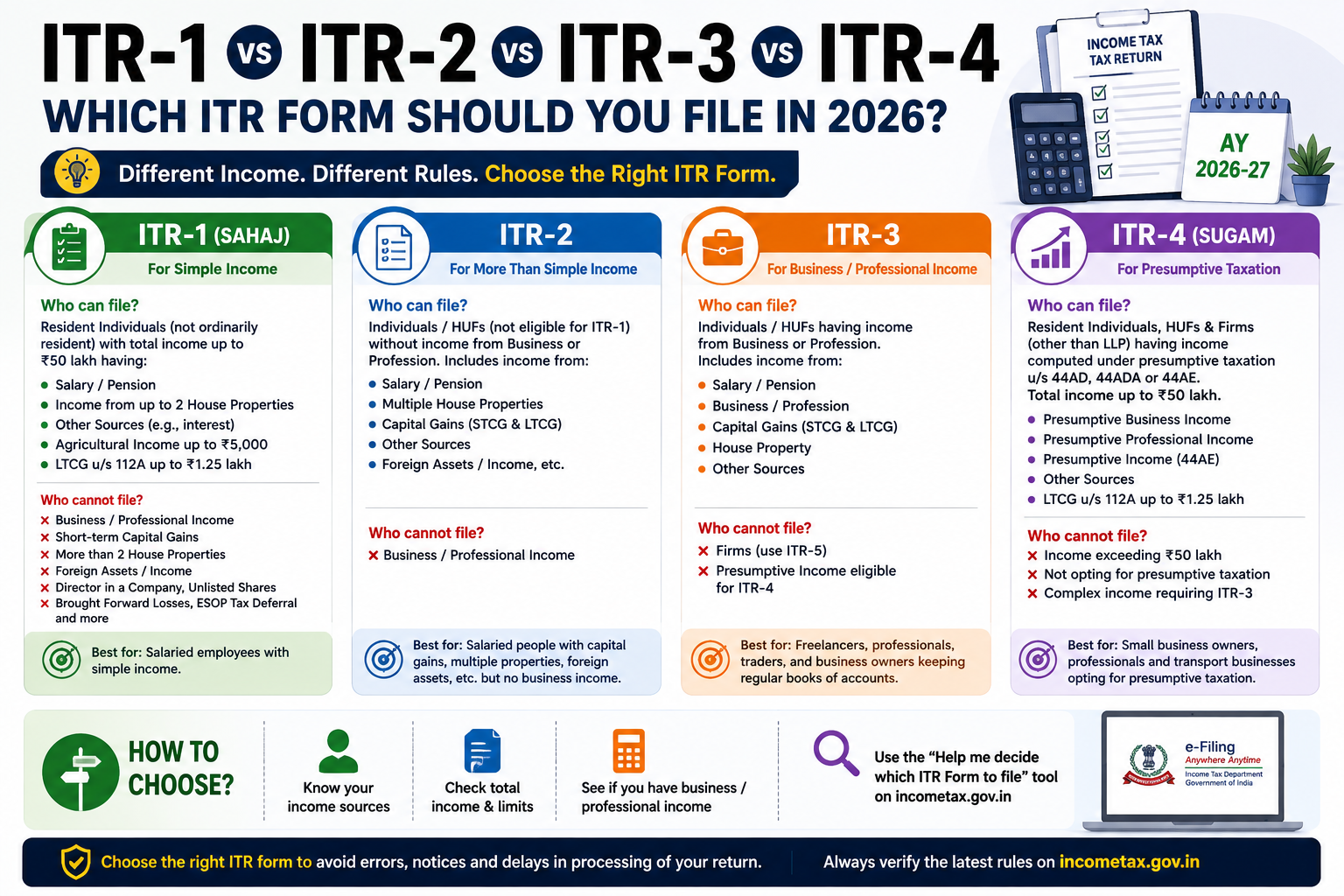
| ITR Form | Generally For | Business/Professional Income? | Capital Gains? |
|---|---|---|---|
| ITR-1 | Eligible resident individuals with simpler income | No | Limited specified LTCG under Section 112A |
| ITR-2 | Individuals/HUFs without business or professional income who aren’t eligible for ITR-1 | No | Yes |
| ITR-3 | Individuals/HUFs with business or professional income | Yes | Yes |
| ITR-4 | Eligible individuals, HUFs and firms using presumptive taxation | Yes, presumptive basis | Limited specified LTCG under Section 112A |
This is only a quick overview. The eligibility conditions are more detailed.
Let’s look at each form.
What Is ITR-1?
ITR-1, also known as Sahaj, is generally the simplest ITR form.
For AY 2026–27, it is available to eligible resident individuals who are not ordinarily resident, with total income up to ₹50 lakh, subject to the conditions prescribed by the Income Tax Department.
Income can include:
- Salary or pension
- Income from up to two house properties
- Certain income from other sources
- Agricultural income up to ₹5,000
- Long-term capital gains under Section 112A up to ₹1.25 lakh, subject to the applicable conditions
Simple Example
Suppose you are a salaried employee.
You earn:
₹10 lakh salary + ₹20,000 bank interest
You don’t have business income, short-term capital gains, foreign assets or other circumstances that make you ineligible.
You may be eligible for ITR-1, subject to the complete eligibility rules.
Who Cannot Use ITR-1?
This is where many beginners make mistakes.
The Income Tax Department lists several situations where ITR-1 cannot be used.
For example, ITR-1 cannot be used by a person who has:
- Business or professional income
- Short-term capital gains
- Long-term capital gains under Section 112A exceeding ₹1.25 lakh
- Income from more than two house properties
- Total income exceeding ₹50 lakh
- Certain foreign assets or foreign income
- An unlisted equity shareholding
- Directorship in a company
- Certain brought-forward or carry-forward losses
- Certain ESOP tax deferral situations
So don’t choose ITR-1 simply because you’re a salaried employee.
Your complete financial situation matters.
What Is ITR-2?
ITR-2 is generally used by individuals and HUFs who don’t have income from profits and gains of business or profession but are not eligible to use ITR-1.
This form covers a wider range of situations.
You may need ITR-2 if you have income from:
- Salary or pension
- House property
- Capital gains
- Other sources
It can also apply in situations involving:
- More than two house properties
- Short-term capital gains
- Certain long-term capital gains
- Higher total income
- Foreign assets or income
- Unlisted shares
- Company directorship
The Income Tax Department states that ITR-2 can be used even where total income exceeds ₹50 lakh, provided the taxpayer otherwise falls within its eligibility conditions.
Example: When Would a Salaried Person Need ITR-2?
Imagine you work for a company and earn ₹12 lakh a year.
You also invested in stocks and sold some shares during the year, resulting in short-term capital gains.
You don’t have business or professional income.
In this situation, you may need ITR-2 rather than ITR-1, because short-term capital gains are not eligible to be reported in ITR-1.
This is one of the most common situations where salaried investors need to look beyond ITR-1.
What Is ITR-3?
ITR-3 is generally applicable to individuals and HUFs having income from profits and gains of business or profession.
This makes ITR-3 particularly important for:
- Business owners
- Professionals
- Certain freelancers
- Self-employed individuals
- Individuals with business-related income
- Certain traders
It can include income under various heads, such as:
- Salary or pension
- House property
- Business or profession
- Capital gains
- Other sources
The Income Tax Department describes ITR-3 as applicable where individuals or HUFs have business or professional income and are not eligible for the simpler applicable forms.
Freelancer? You May Need to Look at ITR-3 or ITR-4
This is especially important for today’s gig economy.
Suppose you work as:
- A graphic designer
- Content writer
- Software developer
- Consultant
- Digital marketer
- Video editor
and earn money independently from clients.
You shouldn’t automatically file ITR-1 just because you don’t own a traditional business.
Your income may be considered professional income, and depending on your circumstances and whether you qualify for presumptive taxation, ITR-3 or ITR-4 may be relevant.
What Is ITR-4?
ITR-4, commonly called Sugam, is a simplified return form available to eligible taxpayers using certain presumptive taxation provisions.
For AY 2026–27, eligible taxpayers can include:
- Resident individuals
- HUFs
- Resident firms other than LLPs
subject to the prescribed conditions.
The Income Tax Department states that ITR-4 can apply where business or professional income is computed on a presumptive basis under Sections 44AD, 44ADA or 44AE, with the applicable income and other conditions.
The total income limit for eligible ITR-4 taxpayers is generally ₹50 lakh, subject to the conditions of the form.
What Is Presumptive Taxation?
This term sounds complicated, but the basic idea is fairly simple.
Under certain provisions of the Income Tax Act, eligible taxpayers can calculate their taxable business or professional income using a prescribed presumptive method instead of maintaining and calculating income in the same way as a regular business taxpayer.
Sections such as 44AD, 44ADA and 44AE are relevant to different categories of eligible taxpayers.
If you’re a freelancer or small business owner considering ITR-4, however, don’t assume you’re automatically eligible.
The conditions need to be checked carefully.
ITR-1 vs ITR-2: What’s the Biggest Difference?
This is one of the most searched questions.
The easiest way to think about it is:
ITR-1 = simpler eligible income situation
ITR-2 = more complex income situation without business/professional income
For example:
You may consider ITR-1 if:
You are an eligible resident individual with salary, limited house-property income, eligible other sources and qualifying Section 112A LTCG within the specified limit.
You may need ITR-2 if:
You have capital gains, more than two house properties, foreign assets/income or other circumstances that make ITR-1 unavailable, while you don’t have business/professional income.
ITR-2 vs ITR-3: What’s the Difference?
The key question is:
Do you have income from business or profession?
If no, ITR-2 may be relevant if you aren’t eligible for ITR-1.
If yes, ITR-3 may be relevant unless you qualify for ITR-4 under the applicable presumptive taxation provisions.
For example:
Salaried employee + stock market capital gains → potentially ITR-2
Freelancer with professional income → potentially ITR-3 or ITR-4
The exact form depends on your circumstances.
ITR-3 vs ITR-4: What’s the Difference?
Both can involve business or professional income, but they’re not interchangeable.
ITR-3
Generally covers individuals and HUFs with business or professional income who aren’t eligible for the simpler applicable forms.
ITR-4
Is a simplified option available to eligible taxpayers using specified presumptive taxation provisions.
So if you’re a freelancer or small business owner, the important question isn’t simply:
“Do I have business income?”
You should also ask:
“Do I qualify for presumptive taxation and the conditions of ITR-4?”
What About Stock Market Investors?
This is increasingly important as more Indians invest through stocks and mutual funds.
A salaried investor with capital gains may not always be eligible for ITR-1.
For example, the Income Tax Department specifically excludes short-term capital gains from ITR-1.
ITR-2 may therefore become relevant for individuals who have capital gains but don’t have business or professional income.
However, tax treatment can become more complicated for active traders, derivatives and business-like trading activities.
Don’t select an ITR form based only on whether you made a profit or loss.
The nature of the activity matters.
What About NRIs?
Non-resident individuals generally aren’t eligible for ITR-1.
The Income Tax Department’s AY 2026–27 guidance lists ITR-2 for eligible non-resident individuals who don’t have business or professional income and ITR-3 where business or professional income applies.
So if you’re an NRI, don’t use the standard salaried-person assumption that ITR-1 is the default.
Your residential status matters.
What If You’re Still Confused?
You don’t necessarily have to guess.
The Income Tax Department provides a “Help me decide which ITR form to file” service.
It asks qualifying questions and helps determine the applicable ITR form and schedules based on your circumstances.
This is particularly useful if you have multiple income sources.
Easy ITR Form Decision Guide
Use this as a starting point:
Are you an eligible resident individual with simple income up to ₹50 lakh?
Yes → Check ITR-1 eligibility.
Do you have capital gains but no business/professional income?
Yes → ITR-2 may be relevant.
Do you have business or professional income?
Yes → Check ITR-3 eligibility.
Do you qualify for specified presumptive taxation under Sections 44AD, 44ADA or 44AE?
Yes → Check whether ITR-4 applies.
Are you an NRI?
Check ITR-2 or ITR-3 depending on your income sources.
Remember, this is a simplified guide—not a substitute for checking the complete eligibility conditions.
Common Mistakes When Choosing an ITR Form
1. Copying Last Year’s ITR
Your income situation can change.
A form that was correct last year may not be correct this year.
2. Assuming Salary Means ITR-1
A salaried person can still need ITR-2 or another form because of investments, foreign assets, capital gains or other circumstances.
3. Ignoring Capital Gains
Selling shares, mutual funds or other investments can create capital gains that affect your return.
4. Confusing Freelancer Income with Salary
Money received from clients isn’t automatically treated like salary from an employer.
5. Choosing ITR-4 Without Checking Eligibility
Presumptive taxation has specific conditions.
Don’t choose ITR-4 just because you’re a small freelancer or business owner.
ITR Form Selection Checklist
Before filing your return, ask yourself:
- What is my residential status?
- What are my income sources?
- Do I have salary or pension?
- Do I have business or professional income?
- Do I have capital gains?
- Do I own more than two house properties?
- Do I have foreign assets or foreign income?
- Do I hold unlisted shares?
- Am I a company director?
- Do I have losses to carry forward?
- Do I qualify for presumptive taxation?
- Is my total income above ₹50 lakh?
Your answers can help determine which ITR form you should investigate.
Frequently Asked Questions
Which ITR form is best for salaried employees?
Eligible salaried employees with simple income situations may be able to use ITR-1. However, capital gains, foreign assets, unlisted shares and other circumstances can make another form applicable.
Which ITR form is used for capital gains?
For individuals without business or professional income, ITR-2 can generally cover capital gains.
Which ITR form is used for freelancers?
Depending on the nature of the professional income and whether the taxpayer qualifies for presumptive taxation, ITR-3 or ITR-4 may apply.
Can ITR-1 be used if I have short-term capital gains?
No. The Income Tax Department specifically lists short-term capital gains among the situations that make a taxpayer ineligible for ITR-1.
Can an NRI file ITR-1?
Generally, no. The AY 2026–27 guidance provides ITR-2 or ITR-3 for eligible non-resident individuals depending on their income.
Is ITR-4 mandatory if I am eligible for it?
No. The Income Tax Department describes ITR-4 as a simplified return form that eligible taxpayers can use when they choose to declare qualifying presumptive business or professional income.
Link back to ITR Filing 2026: Last Date, Documents and How to File Online
Final Thoughts
Choosing the right ITR form doesn’t need to be confusing.
Instead of asking “Which form does everyone use?”, ask a better question:
“What type of income do I have?”
If your income is simple and you meet the conditions, ITR-1 may be enough.
If you have capital gains or other circumstances that make ITR-1 unavailable but don’t have business or professional income, ITR-2 may be relevant.
If you have business or professional income, ITR-3 may apply.
And if you’re eligible for specified presumptive taxation, ITR-4 may offer a simpler filing route.
The most important thing is to check your eligibility before submitting your return.
For AY 2026–27, the Income Tax Department has also provided a tool to help taxpayers determine the appropriate ITR form, so you don’t have to rely entirely on guesswork.
Tax filing is an important part of personal finance. The better you understand your income, investments and tax obligations, the easier it becomes to manage your money with confidence.
Disclaimer: This article is intended for general educational and informational purposes only. It does not constitute tax, legal, financial or investment advice. ITR eligibility can depend on individual facts and circumstances, and tax rules may change. Always verify the latest requirements on the official Income Tax Department portal or consult a qualified tax professional before filing.