UPI vs Credit Cards in 2026: Is Your Credit Card Still Worth Using?
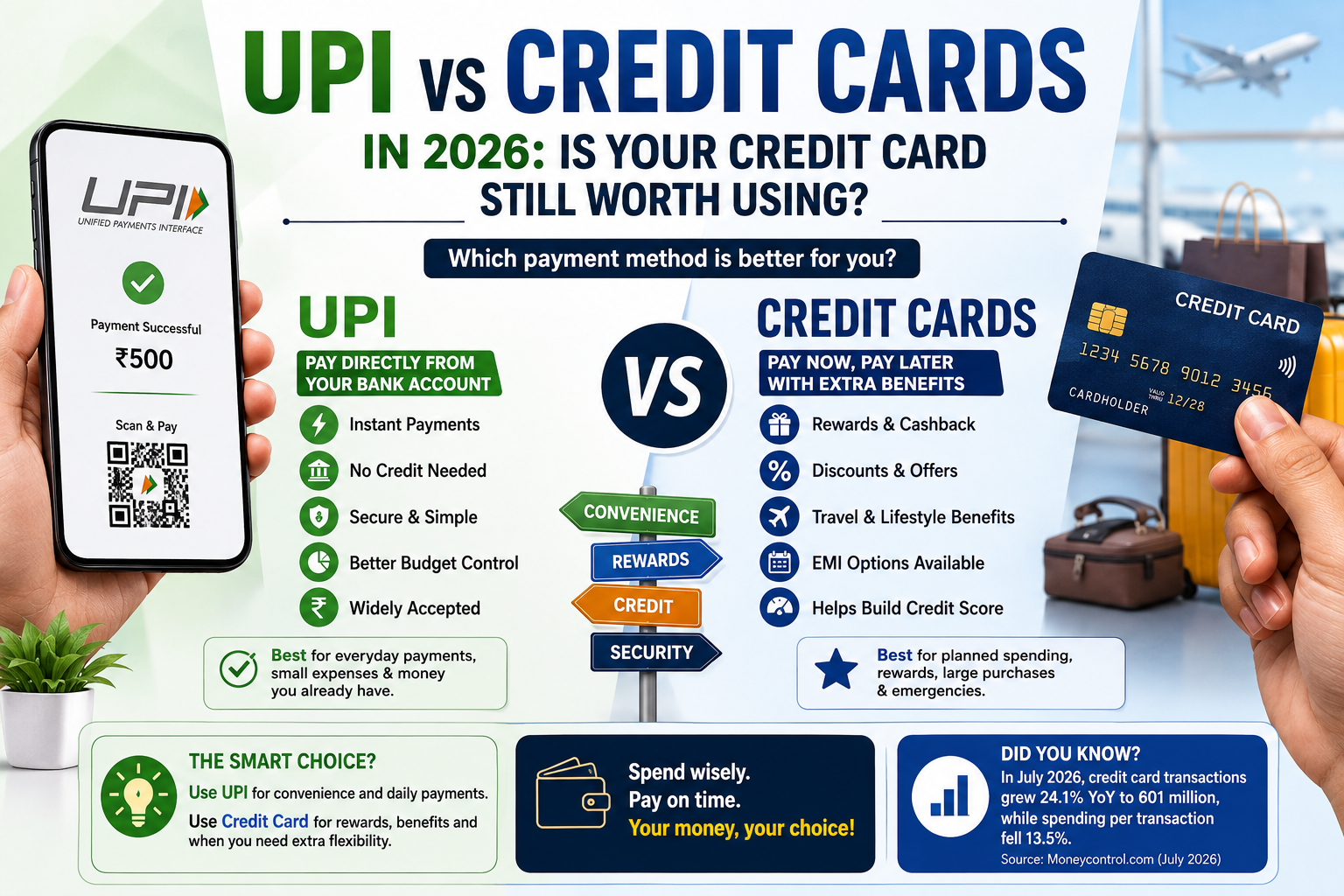
UPI vs Credit Cards in 2026: Is Your Credit Card Still Worth Using?
There was a time when carrying a credit card was almost essential for digital payments.
Today, things are very different.
You can walk into a shop, scan a QR code and pay directly from your bank account using UPI. There is no need to carry cash, swipe a card or even take out your wallet.
But something interesting is happening in India’s payment ecosystem.
UPI is becoming more popular, while credit cards are also being used more frequently.
So, which one is actually better?
Should you use UPI for everything?
Is a credit card still worth keeping?
Or should you combine both?
The answer depends on how you spend, how you manage credit and what benefits you want from your payments.
Recent data makes this comparison even more interesting. In July 2026, India’s credit-card transaction volume increased 24.1% year-on-year to around 601 million transactions, while total credit-card spending rose 7.4% to ₹2.08 lakh crore. At the same time, the average amount spent per credit-card transaction fell 13.5% to about ₹3,460. One factor highlighted in recent analysis is the increasing use of RuPay credit cards through UPI for smaller merchant payments.
Meanwhile, UPI continues to operate at an enormous scale. NPCI data shows that UPI processed more than 2,271 crore transactions in June 2026, worth about ₹28.92 lakh crore.
So, is UPI replacing credit cards?
Not exactly.
Instead, the two payment methods are increasingly being used for different purposes.
Let’s understand the difference.
UPI vs Credit Card: The Basic Difference
Before comparing the benefits, let’s understand how they actually work.
UPI
UPI generally allows you to make a payment directly from your linked bank account.
For example:
You have ₹20,000 in your savings account.
You pay ₹2,000 using UPI.
Your bank account balance becomes approximately ₹18,000, subject to the transaction and any applicable adjustments.
You are using your own money.
Credit Card
A credit card gives you access to a predefined credit limit from the card issuer.
For example:
Your credit limit is ₹1 lakh.
You spend ₹10,000 using the card.
The ₹10,000 becomes part of your card outstanding and must be repaid according to your card’s billing cycle and payment terms.
You are using borrowed money, which is the fundamental difference.
That difference is important because credit cards can be extremely useful when managed responsibly, but expensive when balances are carried without understanding the interest and fees.
Why Is UPI So Popular in India?
One of the biggest reasons is simplicity.
You don’t need to remember a card number.
You don’t need to carry a physical card.
You can often pay by simply scanning a QR code.
UPI has also become deeply integrated into everyday transactions.
You can use it for:
- Grocery shopping
- Restaurants
- Online purchases
- Utility bills
- Travel
- Small merchants
- Food delivery
- Peer-to-peer payments
- Many other everyday transactions
The scale is enormous.
The Government of India reported that UPI had about 55.49 crore users onboarded by June 2026, while July 2026 saw UPI transaction volume reach around 2,366 crore transactions, according to government data.
This explains why UPI has become the default payment method for millions of Indians.
Why Do People Still Use Credit Cards?
If UPI is so convenient, why haven’t credit cards disappeared?
Because credit cards offer something that a direct bank-account payment generally doesn’t:
rewards and access to short-term credit.
Depending on the card, users may receive:
- Cashback
- Reward points
- Airline miles
- Hotel benefits
- Discounts
- Lounge access
- EMI options
- Purchase-related benefits
- Promotional offers
Some credit cards can provide significant value to users who spend regularly and pay their bills on time.
For example, someone who spends ₹30,000 every month on eligible purchases could potentially earn rewards that they wouldn’t receive from ordinary bank-account UPI payments.
But rewards aren’t free money.
A card with a high annual fee may not be worthwhile if your rewards are lower than the cost of keeping the card.
UPI vs Credit Card: Which Is Better?
There isn’t one universal winner.
Instead, think about the following:
| Feature | UPI | Credit Card |
|---|---|---|
| Uses your bank balance | Yes | No |
| Uses credit | No | Yes |
| Rewards | Usually limited/offer-based | Often available |
| Cashback | Limited/varies | Common on some cards |
| Credit score impact | Generally no direct credit-building effect | Can help when managed responsibly |
| Interest risk | No borrowing involved | Yes, if dues aren’t paid as required |
| Small payments | Excellent | Increasingly convenient |
| Merchant QR payments | Excellent | RuPay cards can work on eligible UPI merchant payments |
| Budget control | Easier for many people | Requires discipline |
| Emergency credit | No | Yes, within available limit |
| Annual fees | Usually none for UPI itself | Depends on card |
| International acceptance | Depends on UPI availability | Often broader, depending on card/network |
| Best use | Everyday payments | Rewards, larger purchases and planned spending |
The important point is that UPI and credit cards don’t have to compete for every transaction.
You can use both strategically.
The Biggest Advantage of UPI: No Credit Card Debt
This is perhaps the biggest reason beginners may prefer UPI.
When you pay directly from your bank account, you’re not creating a credit-card bill.
Suppose you have ₹10,000 available and spend ₹2,000 through UPI.
The money leaves your account immediately.
There’s no future credit-card bill waiting for you.
For someone who struggles with spending discipline, this can be a major advantage.
Credit cards can make spending feel less immediate because the money isn’t deducted from your bank account at the time of purchase.
That’s convenient—but it can also encourage overspending.
The Biggest Advantage of Credit Cards: Rewards
Now let’s look at the other side.
Suppose you spend ₹25,000 every month on eligible purchases.
If your card provides meaningful cashback or rewards, you may receive benefits for spending you were going to do anyway.
Over a year:
₹25,000 × 12 = ₹3,00,000 annual spending
Even a modest effective reward rate can add up.
However, this only works if you follow one important rule:
Don’t spend more just to earn rewards.
Spending ₹10,000 unnecessarily to earn ₹100 in rewards isn’t a financial win.
It’s still a ₹9,900 net expense.
RuPay Credit Cards Are Changing the UPI vs Credit Card Debate
This is where the story gets particularly interesting.
Traditionally, UPI and credit cards were separate payment methods.
But RuPay credit cards can be linked to UPI for eligible merchant payments.
NPCI says RuPay credit cards can be linked to a UPI ID and used to pay eligible merchants by scanning a UPI QR code. Payment authentication uses a UPI PIN.
This creates an interesting combination:
UPI’s convenience + credit-card funding + potential card rewards
Instead of taking out a physical card, an eligible RuPay credit card can be selected inside a supported UPI app for an eligible merchant payment.
This is one reason the traditional distinction between “UPI users” and “credit-card users” is becoming less clear.
Can You Use Any Credit Card With UPI?
No.
This is an important point.
You cannot assume that every credit card can simply be linked to UPI.
The specific card, issuer, network, app and transaction type matter.
NPCI’s current RuPay credit-card-on-UPI information lists participating banks and supported applications, but availability can change.
There are also restrictions on the types of transactions that can be made using a RuPay credit card through UPI.
For example, NPCI states that certain categories such as person-to-person transfers, cash withdrawals and other restricted categories aren’t permitted through this functionality.
So don’t assume:
“If I have a credit card, I can use it for every UPI payment.”
The payment method and merchant category matter.
UPI vs Credit Card for Small Payments
For small everyday purchases, UPI is extremely convenient.
Imagine buying:
- A ₹40 tea
- ₹150 snacks
- ₹300 groceries
- ₹500 dinner
- ₹800 local shopping
Scanning a QR code and paying directly from your account can be quick and simple.
But credit cards are increasingly entering this space too.
Recent July 2026 data showed credit-card transaction volume growing much faster than spending value, resulting in a lower average transaction size. Analysis linked part of this shift to smaller-ticket RuPay credit-card transactions through UPI.
This is significant because it suggests credit cards aren’t only being used for large purchases anymore.
UPI vs Credit Card for Large Purchases
For larger purchases, a credit card can have advantages.
Suppose you’re buying an appliance for ₹50,000.
Depending on the card and merchant, you might get:
- Cashback
- Reward points
- Discount
- EMI options
- Purchase-related benefits
But you need to read the terms carefully.
An EMI isn’t automatically cheaper.
There may be:
- Processing fees
- Interest
- GST on applicable charges
- Foreclosure charges
- Other conditions
Always calculate the total amount you’ll pay, not just the monthly EMI.
Which Is Better for Your Credit Score?
This is another major difference.
UPI payments from your bank account don’t work like borrowing on a credit card.
A credit card, on the other hand, is a form of revolving credit.
Responsible credit-card usage can contribute to your credit history.
But missing payments or carrying excessive debt can hurt your financial health and potentially your credit profile.
So if you’re using a credit card to build or maintain a credit history, the goal shouldn’t be:
“Use the card as much as possible.”
The better goal is:
“Use credit responsibly and repay according to the card terms.”
Should You Use Your Credit Card for Every UPI Payment?
Probably not.
The fact that a credit card can be used through UPI doesn’t mean you should use it for every purchase.
Ask yourself three questions:
1. Do I actually have the money to repay the bill?
If the answer is no, avoid using credit for unnecessary spending.
2. Am I earning meaningful rewards?
If you’re paying an annual fee or other charges, calculate whether the benefits justify the cost.
3. Will this payment encourage overspending?
If using credit makes you spend more than planned, UPI from your bank account may be better for you.
UPI vs Credit Card: Which Is Safer?
Both systems have security protections, but users still need to be careful.
With UPI:
- Never share your UPI PIN.
- Don’t approve an unexpected payment request.
- Verify the recipient before paying.
- Be careful with unknown QR codes.
- Don’t share OTPs or sensitive banking information.
NPCI explicitly advises users not to share their UPI PIN and provides security guidance for UPI transactions.
With credit cards:
- Never share your PIN or OTP.
- Don’t share your CVV unnecessarily.
- Turn on transaction alerts.
- Report unauthorized transactions promptly.
- Keep your card secure.
- Review your monthly statement.
The safest payment method is partly determined by how carefully you use it.
A Major Credit Card Mistake: Paying Only the Minimum Amount
This deserves special attention.
Suppose your credit-card statement shows:
Total due: ₹40,000
but the minimum amount due is:
₹2,000
It can be tempting to pay ₹2,000 and continue spending.
But paying only the minimum amount can leave a large balance outstanding, potentially leading to substantial interest and charges depending on your card terms.
The minimum amount is not the same as the amount you should ideally pay.
If possible, pay the full amount due by the applicable due date to avoid revolving credit-card interest under the card’s terms.
This is one reason credit cards should be treated as a payment tool—not free money.
What About UPI Limits?
UPI transactions can be subject to transaction limits, bank limits and category-specific rules.
These limits aren’t necessarily identical across every use case.
For specific RuPay credit-card-on-UPI transactions, NPCI says the applicable limit can be the lowest of the card’s issuer limit, the issuer’s UPI-related risk limit and the customer-set limit where applicable.
Therefore, if you’re planning a large payment, don’t assume your normal UPI limit will automatically apply.
Check your bank or payment app’s current limits.
UPI vs Credit Card for International Spending
This is another area where credit cards can have an advantage.
UPI’s international availability continues to expand, but international acceptance depends on the country, merchant, bank account setup and applicable UPI arrangements.
Credit cards can offer broader international acceptance through their card networks, depending on the card.
However, international credit-card spending may involve:
- Foreign exchange conversion
- Foreign currency markup
- Taxes or other applicable charges
So when travelling internationally, don’t simply look at the reward rate.
Check the foreign transaction charges as well.
Which One Is Better for Beginners?
If you’re new to personal finance, I’d suggest starting with a simple principle:
Use UPI for spending you can afford today.
If you use a credit card, treat it like money you’ve already allocated in your budget.
For example:
Your monthly spending budget is ₹30,000.
You use your credit card for ₹10,000 of planned expenses.
You should already know where that ₹10,000 will come from when the bill arrives.
This mindset can help prevent credit-card debt.
A Smart Strategy: Use Both
You don’t have to choose only one.
A practical strategy could look like this:
Use UPI for:
- Small daily purchases
- Payments where you want immediate bank-account deduction
- Transactions where your credit card isn’t accepted
- Situations where using credit could encourage overspending
Use a credit card for:
- Planned purchases
- Eligible reward/cashback categories
- Larger purchases when you can repay the bill
- Offers that genuinely reduce the cost
- Building responsible credit history
Use RuPay credit card on UPI when:
- Your card and app support it
- The merchant payment is eligible
- The rewards make sense
- You have planned the spending
- You understand the card’s repayment terms
This approach gives you flexibility without making credit the default source of money.
Example: How a Smart User Could Combine UPI and Credit Cards
Let’s say Priya earns ₹60,000 per month.
Her monthly spending looks like:
- Rent: ₹18,000
- Groceries: ₹7,000
- Food: ₹4,000
- Travel: ₹5,000
- Shopping: ₹4,000
- Bills: ₹3,000
- Other expenses: ₹4,000
Instead of putting everything on her credit card, she could decide which purchases provide useful rewards and which are better paid directly through her bank account.
For example:
UPI: everyday small purchases and payments where she wants immediate deduction.
Credit card: planned purchases where her card provides meaningful rewards.
The important part isn’t which payment method she chooses.
It’s that her total spending remains within her budget.
5 Signs You Should Prefer UPI Over a Credit Card
You may be better off using UPI more often if:
1. You frequently overspend with credit cards.
2. You struggle to pay your full credit-card bill.
3. You use credit simply because your bank balance looks higher.
4. Your card rewards are too small to justify the fees.
5. You don’t understand your card’s interest and charges.
In these situations, simplifying your payment system may be more valuable than chasing rewards.
5 Signs a Credit Card May Be Useful for You
A credit card may be useful if:
1. You pay your bills on time.
2. You can afford your purchases without borrowing long-term.
3. Your card provides rewards that match your spending.
4. The annual fee is justified by the benefits you actually use.
5. You want a convenient payment and credit-history tool.
The key word here is discipline.
A good credit card user doesn’t ask:
“How much can I spend?”
They ask:
“How much can I comfortably repay?”
UPI vs Credit Card: The Final Verdict
So, is your credit card still worth using in 2026?
Yes—but not for everyone and not for every transaction.
UPI has become the backbone of everyday digital payments in India because it’s fast, convenient and directly connected to bank accounts.
Credit cards remain useful because they can provide rewards, cashback, payment flexibility and access to credit when used responsibly.
And the rise of RuPay credit cards on UPI is bringing the two worlds closer together.
The recent data is particularly interesting: credit-card transaction volume rose strongly in July 2026 even though average spending per transaction declined, while UPI continued operating at enormous scale.
This doesn’t mean one technology has “won.”
Instead, Indian consumers are getting more choices.
The smartest approach isn’t:
UPI OR Credit Card
It’s:
UPI + Credit Card + Good Money Habits
Use UPI when you want simplicity and direct payment from your bank account.
Use a credit card when the rewards, convenience or payment benefits genuinely make sense—and only when you can manage the repayment responsibly.
And if you’re using a RuPay credit card through UPI, remember that not every UPI transaction is eligible and the applicable rules and limits can vary.
Ultimately, the best payment method isn’t the one offering the biggest cashback.
It’s the one that helps you spend within your means while getting the most useful benefits from your money.
Frequently Asked Questions
Is UPI better than a credit card?
Neither is automatically better. UPI is excellent for direct bank-account payments and everyday spending, while credit cards can provide rewards, cashback and access to credit. The right choice depends on your spending habits.
Can I use my credit card through UPI?
Eligible RuPay credit cards can be linked to UPI for eligible merchant payments. Not every credit card or every UPI transaction is supported.
Is paying through UPI safer than using a credit card?
Both have security protections. Your own habits are also important. Never share your UPI PIN, card PIN, CVV or OTP with anyone.
Does UPI improve your credit score?
Normal UPI payments from your bank account aren’t a substitute for responsible credit usage and don’t function like credit-card borrowing.
Can credit cards help build a credit history?
Responsible credit-card use can contribute to your credit history. However, missed payments, excessive borrowing and poor repayment habits can create financial problems.
Should I use a credit card for every purchase?
No. Use a credit card selectively when it provides a genuine benefit and you can comfortably repay the bill.
Is RuPay credit card on UPI available everywhere?
No. Availability depends on the participating card issuer, UPI application and eligible merchant transaction. NPCI maintains information on participating banks and applications.
Why are credit-card transactions increasing while average spending is falling?
Recent July 2026 data showed credit-card transaction volume increasing 24.1% year-on-year while average transaction value declined 13.5%. Recent analysis associated the lower ticket sizes partly with smaller RuPay credit-card transactions through UPI.
Final Takeaway
If you remember only five things from this article, remember these:
1. UPI is excellent for everyday payments.
2. Credit cards can be valuable for rewards and planned spending.
3. RuPay credit cards are bringing credit-card payments into the UPI ecosystem.
4. Never use a credit card simply because you have available credit.
5. The best payment method is the one that fits your budget and financial goals.
Your payment method is only one part of personal finance.
Your spending habits matter much more.
Disclaimer: This article is intended for general educational and informational purposes only. It is not financial, investment, banking, tax or legal advice. Credit-card benefits, fees, interest rates, limits and eligibility vary by issuer and can change. UPI and RuPay features may also be subject to applicable bank, NPCI and regulatory rules. Always check the latest terms and conditions of your bank, card issuer and payment provider before making financial decisions.