AI Payments in India: How Agentic UPI Could Change the Way You Pay
AI Payments in India: How Agentic UPI Could Change the Way You Pay
Imagine waking up in the morning and telling your AI assistant:
“Order my usual groceries. Keep the total below ₹2,000.”
You don’t open your banking app.
You don’t scan a QR code.
You don’t enter a UPI PIN for every individual purchase.
Instead, your AI agent checks the task, finds the appropriate merchant, follows the spending limit you have given it and completes an eligible payment on your behalf.
This may sound like something from the future.
But India is now preparing for a version of exactly this idea.
According to a Reuters report published on September 1, 2026, India is preparing an agentic payments framework on UPI that could allow AI agents to execute small-value digital transactions without requiring the user to approve every individual payment. The proposed framework is expected to use safeguards such as spending limits, identity verification and audit trails.
This could represent a major change in the way people think about digital payments.
For more than a decade, the basic model has been:
Person → Payment App → Bank → Merchant
The next model could become:
Person → AI Agent → UPI → Merchant
But what exactly are agentic payments?
Are they safe?
Will AI really be allowed to spend your money?
And does this mean your phone could soon make payments without you touching it?
Let’s break it down in simple language.
What Are AI or Agentic Payments?
The word “agentic” comes from AI agents.
A normal AI chatbot usually responds to what you ask.
For example:
“Find me a hotel in Mumbai under ₹5,000.”
It might search and give you options.
An AI agent is designed to go a step further.
Depending on the system and permissions it has, an agent can potentially:
- Understand your instructions
- Search for options
- Compare them
- Make decisions within defined rules
- Complete tasks
- Interact with other systems
- Take an action on your behalf
In the case of payments, that action could eventually include completing an eligible UPI transaction.
The important part is that the AI would not simply have unlimited access to your bank account.
The proposed system is expected to include controls such as spending limits, identity verification and transaction records, according to Reuters.
So the idea isn’t:
“Give AI access to my entire bank account.”
It’s closer to:
“Give AI permission to spend a limited amount for a specific purpose.”
That distinction is extremely important.
Why Is India Exploring AI Payments Now?
India already has one of the world’s largest digital payment ecosystems.
UPI has become part of everyday life for millions of people.
The scale continued to grow in August 2026.
According to NPCI data reported on September 1, UPI processed 24.51 billion transactions worth ₹29.82 lakh crore during August 2026. Transaction volume was up about 22% from August 2025.
That means India already has the payment infrastructure needed for extremely large numbers of digital transactions.
The next question is:
What happens when software can initiate some of those transactions on behalf of people?
That’s where agentic payments come in.
Instead of making humans manually complete every small digital transaction, AI could eventually handle certain repetitive tasks under predefined rules.
This could be especially useful for people who regularly pay for:
- Groceries
- Subscriptions
- Utility services
- Food
- Travel
- Household purchases
- Business expenses
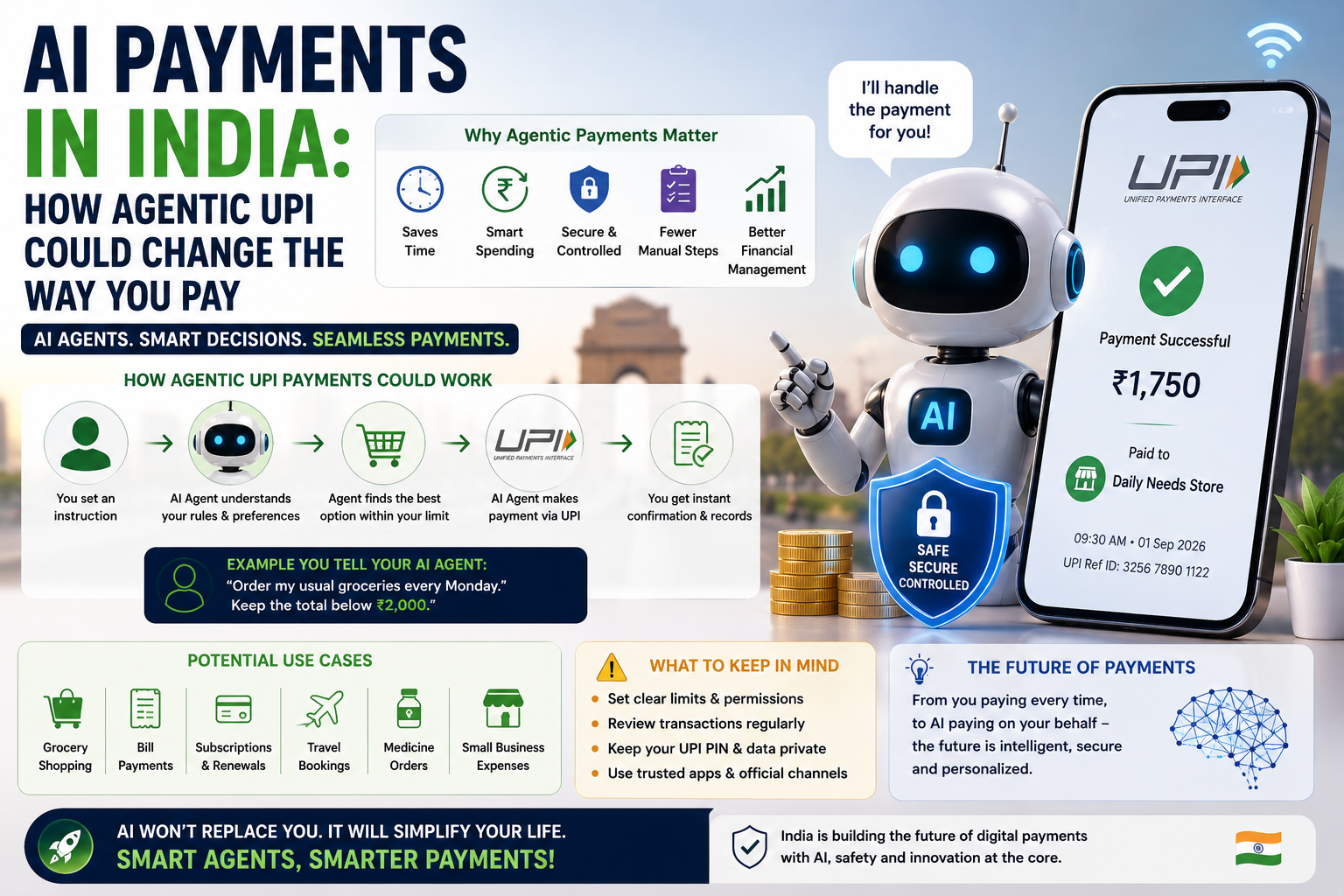
How Could Agentic UPI Payments Work?
Let’s take a simple example.
Suppose you tell your AI assistant:
“Every Monday, buy my usual groceries. Don’t spend more than ₹2,000.”
The system could potentially work something like this:
Step 1: You Give the Instruction
You tell your AI agent what you want.
For example:
“Buy groceries every Monday under ₹2,000.”
Step 2: The AI Understands Your Rules
The agent understands:
- What you want
- Your spending limit
- The frequency
- Potential merchant options
- Other restrictions you’ve configured
Step 3: The Agent Finds a Suitable Option
The AI could compare eligible merchants or products.
For example:
Store A: ₹1,750
Store B: ₹1,890
Store C: ₹2,150
If your rule says the maximum is ₹2,000, the AI can ignore Store C.
Step 4: Payment Authorization
The payment system checks whether the transaction falls within the permission you’ve granted.
Step 5: UPI Payment
If everything meets the conditions, the eligible payment could be processed through the UPI ecosystem.
Step 6: You Receive a Record
You could receive a notification showing:
₹1,750 paid
Groceries
Merchant: XYZ
This creates a very different payment experience.
Instead of telling your phone:
“Pay ₹1,750.”
You could tell it:
“Make sure my groceries are purchased every week within my budget.”
The AI handles the task.
Does This Mean AI Can Spend Your Money Without Permission?
This is probably the first question most people will ask.
Not in the sense of giving an AI unlimited access to your bank account.
The proposed agentic-payment framework is expected to have controls around the authority given to AI agents.
Reuters reports that the framework would include safeguards such as:
- Spending limits
- Identity verification
- Audit trails
- Merchant integration infrastructure
The report also says the system could build on existing UPI features such as UPI Circle and Reserve Pay to provide conditional payment authority and fund blocking.
This is important because AI payments create a completely different security challenge.
With a normal UPI payment, you initiate the transaction.
With an agentic payment, software may initiate the transaction based on instructions you previously gave it.
That means the permission system has to be extremely clear.
What Is the Difference Between UPI AutoPay and Agentic Payments?
You may be thinking:
“But UPI already has automatic payments.”
That’s true.
UPI AutoPay already allows users to create mandates for recurring payments such as subscriptions and bills.
For example:
Netflix subscription → automatic payment
Insurance premium → automatic payment
Monthly subscription → automatic payment
Agentic payments are potentially broader.
UPI AutoPay
You generally create a predefined mandate.
Example:
“Pay ₹999 every month.”
Agentic Payment
You could potentially give an AI agent a goal and a set of conditions.
Example:
“Buy groceries once a week, but keep each purchase below ₹2,000.”
The AI could potentially make decisions within the permission you provide.
That’s a major difference.
AutoPay follows a predefined payment instruction.
An AI agent could potentially make decisions before initiating the payment.
Why Could AI Payments Be Useful?
The biggest advantage could be convenience.
We already spend a surprising amount of time making small financial decisions.
Think about your normal week.
You may need to:
- Pay bills
- Buy groceries
- Renew subscriptions
- Order household products
- Book travel
- Pay service providers
- Check prices
- Remember due dates
An AI agent could potentially handle some of these repetitive tasks.
That could save time.
But convenience isn’t the only potential benefit.
1. AI Could Help With Budgeting
Imagine telling your AI:
“Keep my food spending below ₹8,000 this month.”
The AI could potentially track eligible purchases and warn you when you’re approaching the limit.
Eventually, it could potentially make purchases while staying inside the budget you’ve configured.
This could turn a simple payment system into something closer to an automated personal finance assistant.
Instead of only asking:
“Can I pay?”
the system could also consider:
“Does this purchase fit the user’s rules?”
2. AI Could Compare Prices Before Paying
Imagine you’re buying a product for ₹4,000.
Instead of manually checking several websites, your AI agent could potentially compare available options.
For example:
Merchant A: ₹4,000
Merchant B: ₹3,750
Merchant C: ₹3,900
You could tell the AI:
“Buy the cheapest option from a trusted merchant, provided delivery is within three days.”
The AI would then have a clear objective.
This could make digital commerce much more automated.
3. AI Could Manage Routine Payments
Some payments are predictable but annoying.
For example:
- Electricity
- Internet
- Mobile recharge
- Software subscriptions
- Streaming services
- Regular household purchases
An AI agent could potentially monitor these tasks and act when the conditions are met.
Instead of remembering everything yourself, you could give the agent rules.
4. AI Could Help Small Businesses
The technology could also have applications beyond individual consumers.
Consider a small business owner.
Every month, the business may need to:
- Order supplies
- Pay approved vendors
- Purchase inventory
- Renew software
- Pay service providers
- Manage routine expenses
An AI agent could potentially handle some repetitive tasks while staying within company-approved limits.
This could save business owners time.
However, business payments would also require stronger controls because the amounts can be much larger.
5. AI Could Make Payments More Personalized
Today, most payment apps are primarily tools.
In the future, they could become more like assistants.
For example:
“I’m travelling to Goa next week. Keep my food and local transport spending below ₹10,000.”
An AI assistant could potentially help organize eligible purchases around that budget.
The payment system becomes part of a broader financial-management experience.
What Could Go Wrong?
This is where the discussion becomes much more important.
AI payments could be extremely convenient.
But convenience and financial risk often grow together.
If an AI makes a mistake while writing an email, you can usually correct it.
If an AI makes a wrong payment, the consequences can be financial.
That’s why agentic payments need strong safeguards.
Risk 1: AI Could Make the Wrong Decision
Imagine telling your AI:
“Buy my usual groceries.”
What if prices suddenly increase?
What if your normal product is unavailable?
What if the AI chooses a more expensive alternative?
What if it misunderstands your instructions?
A human might notice the difference before paying.
An automated system may not.
That’s why spending limits and clear rules are critical.
Risk 2: Fraudsters Could Target AI Agents
Traditional scams already target UPI users.
AI agents introduce another possible attack surface.
Imagine a malicious website attempting to manipulate an AI agent into believing that a particular payment is necessary.
Or imagine someone gaining unauthorized access to an agent’s payment permissions.
The potential consequences could be serious.
This means identity verification, transaction monitoring, permissions and audit logs will become extremely important.
Reuters reports that the proposed framework is expected to include safeguards such as identity verification and audit trails.
Risk 3: Users Could Give AI Too Much Permission
This may actually become one of the biggest consumer mistakes.
Imagine giving an AI:
“You can spend anything you need.”
That’s dangerous.
A better approach would be:
“You can spend up to ₹2,000 per transaction and ₹10,000 per month on groceries.”
The second instruction creates a clear boundary.
In the AI-payment era, permission management could become as important as password management is today.
Risk 4: Hidden Spending Could Become Easier
Credit cards already make it easy to spend without seeing money leave your bank account immediately.
AI payments could make spending even more invisible.
Imagine several automated purchases happening during the month.
₹500 here.
₹900 there.
₹1,200 somewhere else.
Individually, they may not look significant.
Together, they could become a large expense.
Therefore, AI payment systems will need strong notifications and easy-to-understand spending dashboards.
Risk 5: AI Could Be Manipulated
AI systems don’t operate in a perfect world.
They interact with websites, merchants, data and instructions.
If an AI agent receives misleading information, it could potentially make the wrong choice.
This is why the future of agentic payments isn’t just about making AI smarter.
It is also about making financial permissions safer.
Will AI Replace Google Pay, PhonePe and Paytm?
Probably not in the simple sense people may imagine.
Instead, AI agents could eventually work through existing payment infrastructure.
Reuters reports that the proposed system is expected to operate on UPI and could involve existing UPI mechanisms and merchant infrastructure.
So your familiar payment apps may remain important.
The difference could be that you don’t manually initiate every transaction.
Think about it like this:
Today
You → PhonePe/Google Pay/another UPI app → Merchant
Possible future
You → AI Agent → UPI infrastructure → Merchant
The payment network doesn’t necessarily disappear.
The interface changes.
What Is the Unified Agent Protocol?
India is reportedly preparing a Unified Agent Protocol as part of this move toward agentic payments.
According to Reuters, the protocol is expected to support initial use cases such as grocery purchases and could later expand toward more automated shopping and other financial decisions.
The exact implementation, rollout and consumer availability should be treated as evolving.
This is important:
Agentic UPI payments are not something every Indian consumer can simply switch on today.
The framework is being prepared, and details may change as the system develops.
So consumers shouldn’t assume that AI can currently make unrestricted UPI payments on their behalf.
Why This Could Be a Big Deal for India’s Digital Economy
India already has massive digital-payment adoption.
August 2026 UPI transaction volume reached 24.51 billion, worth approximately ₹29.82 lakh crore, according to NPCI data.
That scale gives India a strong foundation for experimenting with the next stage of digital commerce.
If agentic payments work well, the impact could extend beyond individual consumers.
It could affect:
- E-commerce
- Banking
- Fintech
- Retail
- Travel
- Food delivery
- Subscription services
- Small businesses
- Personal finance apps
The biggest change may not be the payment itself.
It could be the shift from manual transactions to goal-based transactions.
Imagine a Future Shopping Experience
Here’s what a future AI-assisted payment could look like.
You tell your AI:
“I need a new pair of running shoes. Budget ₹5,000. Size 8. Buy only from a trusted seller. I need them before Friday.”
The AI could potentially:
- Search products.
- Compare prices.
- Check seller information.
- Check delivery dates.
- Confirm that the purchase meets your rules.
- Initiate an eligible payment.
- Send you the transaction details.
You didn’t manually:
- Search five websites
- Compare prices
- Open your payment app
- Scan a QR code
- Enter payment details
The AI handled the process.
This is the bigger vision behind agentic commerce.
Could AI Eventually Make Investment Decisions?
This is where things become much more complicated.
Reuters reports that the proposed framework could eventually expand beyond simple shopping toward more automated financial activities, including investment-related decisions.
But investing is very different from buying groceries.
A ₹1,500 grocery purchase and a ₹1.5 lakh investment should not be treated the same way.
Investment decisions involve:
- Risk
- Market volatility
- Financial goals
- Time horizon
- Tax considerations
- Personal circumstances
Therefore, any future AI system handling financial decisions would need much stronger safeguards than a simple shopping agent.
Consumers should also be cautious about allowing AI to make financial decisions automatically.
How Consumers Should Prepare for AI Payments
You don’t need to change your financial habits today just because agentic payments are coming.
But there are a few useful habits worth developing.
1. Understand Your UPI Settings
Know which accounts and payment methods are connected to your UPI apps.
2. Use Transaction Alerts
Notifications make it easier to spot unusual activity quickly.
3. Set Spending Limits Where Available
Don’t give automated systems unlimited authority.
4. Review Recurring Payments
Know what subscriptions and mandates are active.
5. Never Share Your UPI PIN
Your UPI PIN should remain private.
6. Check Transactions Regularly
Even if AI handles some payments, you should still review your financial activity.
7. Don’t Trust AI Blindly
AI can make mistakes.
Treat it as an assistant—not as someone who is automatically right.
AI Payments vs Traditional UPI
Here’s the simplest comparison:
| Feature | Traditional UPI | Agentic UPI |
|---|---|---|
| Who starts payment? | User | AI agent may initiate within permission |
| User involvement | Usually every transaction | Potentially lower for eligible transactions |
| Spending rules | Mostly user-controlled manually | Could be defined as AI instructions |
| Automation | Limited/mandate-based | Potentially much broader |
| Convenience | Very high | Potentially extremely high |
| Risk | User mistakes/scams | User + AI + system risks |
| Best use | Everyday payments | Repetitive or rule-based tasks |
| Key requirement | User authentication | Strong permission and identity controls |
The agentic model isn’t necessarily designed to replace normal UPI.
It could become another layer on top of the payment ecosystem.
Is Agentic UPI Safe?
The honest answer is:
It depends on how the final system is designed and how users control it.
The proposed framework reportedly includes safeguards such as spending limits, identity verification and audit trails.
Those safeguards will be extremely important.
A good agentic-payment system should make it easy for users to answer:
- How much can my AI spend?
- Where can it spend?
- What can it buy?
- How often can it pay?
- What happens if something goes wrong?
- Can I immediately stop the permission?
- Can I see every transaction?
- Can I dispute an unauthorized payment?
If users can’t answer these questions, automated payments become much harder to trust.
The Biggest Change May Be Psychological
For years, we’ve thought about money like this:
“I need to make a payment.”
AI could change that thinking to:
“I need something done.”
The payment becomes part of the task.
You don’t necessarily care about the individual transaction process.
You care about the outcome.
For example:
“Keep my electricity bill paid.”
“Keep my grocery spending below ₹8,000.”
“Book the cheapest suitable flight.”
“Renew my insurance before it expires.”
That is a major shift in how people may interact with financial technology.
Should You Be Excited or Worried?
Probably a little of both.
Reasons to be excited
- Less repetitive work
- Faster payments
- Automated budgeting
- Easier shopping
- More personalized financial tools
- Potentially better price comparison
- Greater convenience
Reasons to be cautious
- AI mistakes
- Fraud
- Unauthorized access
- Over-spending
- Privacy concerns
- Incorrect decisions
- Difficulty understanding automated transactions
The future of payments shouldn’t simply be:
“Let AI do everything.”
It should be:
“Let AI do the right things within clearly defined boundaries.”
Final Verdict: Is AI Going to Change UPI?
Very likely.
India’s UPI ecosystem has already changed how people pay.
The next major shift could be changing who initiates the payment.
Instead of humans manually making every transaction, AI agents could eventually perform certain tasks on their behalf.
India is now preparing a framework for this possibility, with proposed safeguards around spending limits, identity verification and transaction records.
At the same time, UPI itself continues to grow at enormous scale, processing a record 24.51 billion transactions in August 2026 worth about ₹29.82 lakh crore.
That combination makes India an especially interesting market for AI-powered payments.
But consumers shouldn’t think of agentic payments as:
“AI gets access to my bank account.”
A safer way to think about it is:
“I give an AI agent limited permission to complete specific financial tasks for me.”
The difference between those two ideas could determine whether AI payments become a useful financial tool—or a new source of financial risk.
For now, the technology is still developing.
But one thing is becoming clear:
The future of UPI may not be just about paying faster.
It could be about letting AI decide when, where and how an eligible payment should happen—within rules you control.
And when that happens, your relationship with your payment app could change from “I use it to pay” to “I tell it what I want, and it helps make it happen.”
Frequently Asked Questions
What are agentic payments?
Agentic payments are payments initiated or managed by AI agents on behalf of users, usually according to predefined instructions, permissions and spending limits.
What is agentic UPI?
Agentic UPI refers to the planned use of AI agents with India’s UPI payment infrastructure to automate certain eligible payments. India is preparing a framework for this type of payment system.
Can AI make UPI payments today?
Consumers should not assume that unrestricted AI-initiated UPI payments are currently available. India is preparing the framework, and the exact rollout and features are still developing.
Will AI agents have unlimited access to my bank account?
The proposed framework is expected to use controls such as spending limits, identity verification and audit trails rather than unrestricted payment access. The final implementation and safeguards will determine how the system works in practice.
Is agentic UPI the same as UPI AutoPay?
No. UPI AutoPay is primarily designed for recurring payments based on mandates. Agentic payments could potentially allow AI agents to make decisions and execute eligible transactions within user-defined rules.
Why is agentic UPI important?
It could make digital commerce more automated by allowing AI agents to complete repetitive or rule-based tasks instead of requiring users to manually initiate every payment.
How many UPI transactions were made in August 2026?
UPI processed a record 24.51 billion transactions worth approximately ₹29.82 lakh crore in August 2026, according to NPCI data.
Can AI agents eventually handle investments?
The potential use of agentic systems may eventually extend beyond simple purchases, but investment decisions involve substantially higher financial risks. Consumers should not assume that automated investment decisions are currently available or appropriate without appropriate safeguards and professional advice.
Key Takeaway
AI isn’t necessarily replacing UPI.
AI could become the new user of UPI.
Today:
You → UPI → Merchant
Tomorrow, potentially:
You → AI Agent → UPI → Merchant
The biggest question isn’t whether AI can make payments.
It’s whether we can build a system where AI has enough freedom to be useful—but enough limits to keep our money safe.
That balance will determine whether agentic payments become one of India’s biggest fintech innovations or simply another technology people hesitate to trust.
Disclaimer: This article is for educational and informational purposes only and does not constitute financial, investment, banking, legal or technology advice. Agentic-payment features, UPI rules, limits and availability may change as the framework develops. The article discusses a proposed/emerging payment model and should not be interpreted as confirmation that every described feature is currently available to consumers. Always verify the latest information with official payment providers, NPCI, RBI and other relevant authorities before making financial decisions.