ITR Filing 2026: A Simple Guide to Filing Your Income Tax Return Online
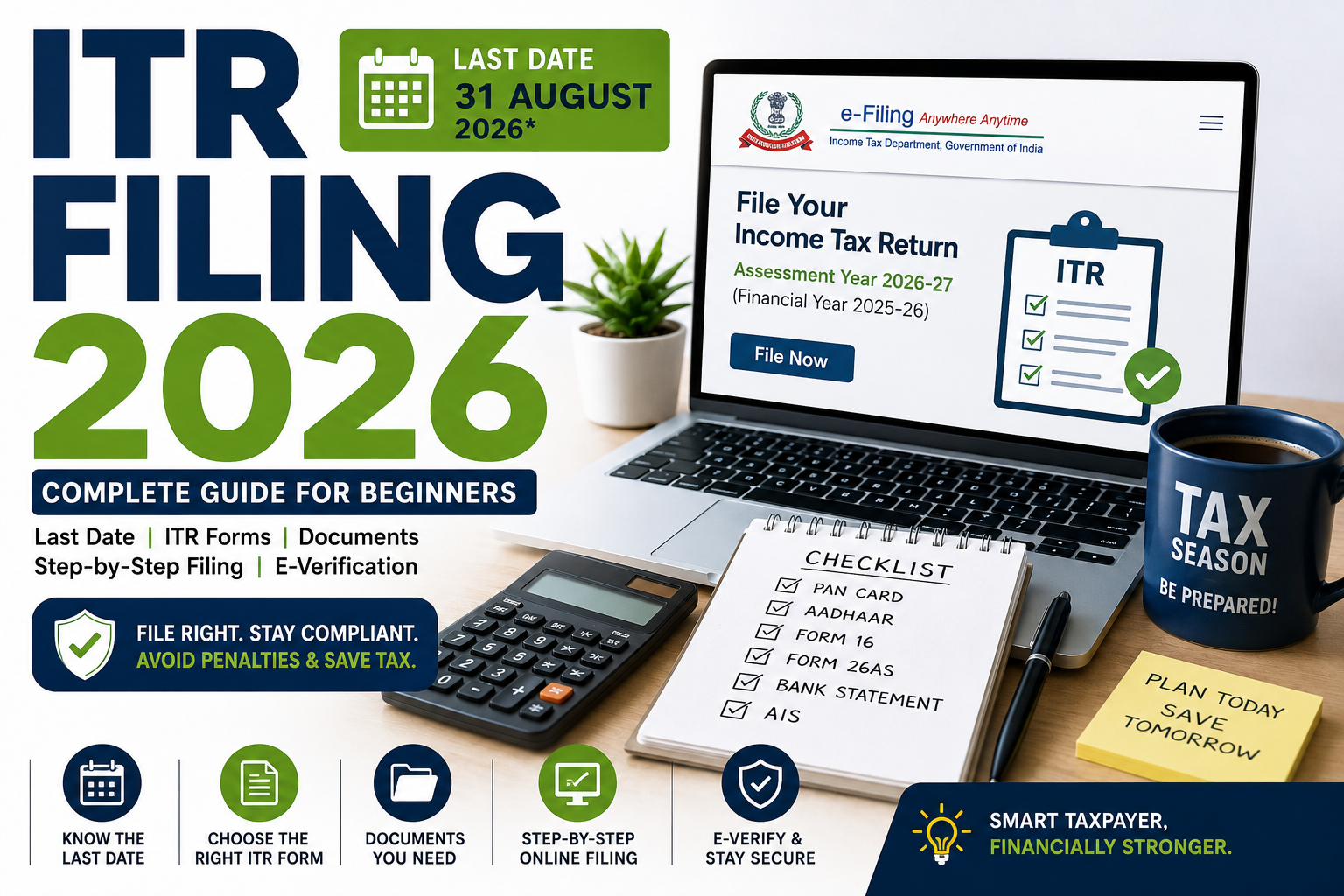
Filing an Income Tax Return can feel complicated, especially if you’re doing it for the first time.
You may have questions like: Do I need to file an ITR? Which ITR form should I choose? What documents do I need? What is AIS? How do I check my tax details? And what happens after submitting the return?
If these questions sound familiar, you’re not alone.
The good news is that ITR filing becomes much easier once you understand the process step by step.
For Assessment Year (AY) 2026–27, taxpayers are filing returns for income earned during Financial Year (FY) 2025–26. The Income Tax Department has clarified that returns for FY 2025–26 are filed under the Income Tax Act, 1961 framework applicable to that assessment year.
This guide explains the important things you should know about ITR filing 2026, including deadlines, forms, documents, online filing, e-verification and common mistakes.
Important: Tax rules can change, and your applicable deadline depends on your circumstances. Always verify the latest information with the Income Tax Department before filing.
What Is an Income Tax Return?
An Income Tax Return (ITR) is a form used to report your income and other relevant financial information to the Income Tax Department.
Depending on your situation, your income may come from:
- Salary
- Freelancing
- Business
- Professional services
- Bank interest
- Fixed deposits
- Rental income
- Capital gains
- Other sources
When you file an ITR, you provide information about your income, taxes already paid, eligible deductions and other applicable details.
After processing your return, you may either have additional tax to pay or become eligible for a refund if excess tax was already deducted or paid.
What Is AY 2026–27?
This is one of the most common points of confusion for beginners.
If you earned income during FY 2025–26, the corresponding return is generally filed for AY 2026–27.
Think of it this way:
Income earned: FY 2025–26
ITR filed for: AY 2026–27
The Income Tax Department specifically states that income earned during FY 2025–26 is reported for AY 2026–27.
So when you log into the e-filing portal, make sure you select the correct assessment year.
ITR Filing Last Date 2026
The deadline depends on your taxpayer category and whether your accounts are subject to audit.
For many taxpayers who are not subject to audit, the applicable extended deadline for AY 2026–27 is 31 August 2026. For example, the Income Tax Department confirms 31 August 2026 as the due date for eligible ITR-4 filers.
Taxpayers whose accounts are subject to audit can have a different deadline.
This distinction is important because simply searching for “ITR last date 2026” may not give you a deadline that applies to your individual situation.
What If You Miss the ITR Deadline?
Missing the applicable due date does not necessarily mean you cannot file your return.
A belated return may be filed within the permitted period, but late filing can result in applicable fees and interest depending on your circumstances.
For AY 2026–27, the Income Tax Department states that a belated return can generally be furnished by 31 December 2026, or before completion of assessment, whichever is earlier.
However, waiting until after the deadline is usually not a good strategy if you can file on time.
Who Needs to File an ITR?
Whether you are required to file an ITR depends on your income and other conditions prescribed under tax law.
You may also choose to file an ITR even in situations where you aren’t otherwise required to do so because having a tax-return record can be useful for certain financial purposes.
For example, an ITR may be requested as part of documentation for:
- Home loans
- Personal loans
- Visa applications
- Financial applications
- Certain business requirements
However, don’t assume that filing an ITR is optional simply because your employer deducted tax or because your final tax liability is low.
Your actual filing requirement depends on your circumstances.
Use the official Income Tax e-Filing portal.
Which ITR Form Should You Choose?
Choosing the correct ITR form is one of the most important steps.
Different forms apply to different taxpayers and income situations.
ITR-1
ITR-1, also called Sahaj, is designed for eligible resident individuals with relatively straightforward income situations, subject to the form’s conditions.
For AY 2026–27, the Income Tax Department’s information includes eligible individuals with income from salary/pension, certain house-property income, other sources and specified long-term capital gains within the prescribed limits.
ITR-2
ITR-2 is generally applicable to individuals and HUFs who are not eligible to file ITR-1 and who do not have income from business or profession.
ITR-3
ITR-3 is generally relevant to individuals and HUFs having income from business or profession.
This can include certain freelancers, professionals, traders and business owners.
If you’re involved in F&O trading, for example, don’t automatically assume that a simple salary-based ITR form is appropriate.
ITR-4
ITR-4, commonly known as Sugam, is available to eligible taxpayers meeting the prescribed conditions.
For AY 2026–27, the Income Tax Department states that eligible ITR-4 taxpayers can have total income up to ₹50 lakh and may include certain presumptive business or professional income, along with specified other income sources.
Important Tip
Don’t select an ITR form just because your friend, colleague or relative uses the same form.
Your income sources and financial circumstances determine which form may apply.
Documents Required for ITR Filing
You don’t normally upload every supporting document with your ITR, but you should keep your records ready.
Here are some important documents and information you may need.
1. PAN
Your PAN is an essential tax identification number.
Make sure the details are correct.
2. Aadhaar
Keep your Aadhaar information available, particularly where it is required for applicable verification or linking processes.
3. Form 16
Salaried employees generally receive Form 16 from their employer.
It contains important information about salary and tax deducted during the financial year.
4. Form 26AS
Form 26AS provides important tax-related information associated with your PAN.
Check it before filing so you can identify potential mismatches.
5. Annual Information Statement
The Annual Information Statement (AIS) is another important source of information.
It can contain details about various financial transactions and reported income.
Before submitting your ITR, compare the information available in your records with the information reflected in AIS and other tax records.
6. Bank Statements
Bank statements can help you identify:
- Savings interest
- Fixed-deposit interest
- Other income
- Transactions that may need to be considered while preparing your return
7. Investment Records
If you have investments, keep relevant records available.
Depending on your situation, this can include information about mutual funds, shares, property transactions or other investments that may have tax implications.
How to File ITR Online in 2026
The Income Tax Department provides online facilities for filing applicable returns.
Here’s a simple overview.
Step 1: Log In
Go to the official Income Tax e-Filing portal and log in using your account credentials.
Step 2: Select AY 2026–27
Choose AY 2026–27 when filing the return for income earned during FY 2025–26.
Step 3: Select the Correct ITR Form
Choose the form that matches your income and eligibility.
Step 4: Check Your Personal Details
Review your:
- Name
- PAN
- Contact information
- Bank account details
- Other personal information
Step 5: Review Your Income
Check salary, business income, interest, capital gains and other applicable sources.
Don’t assume that your salary is your only taxable income.
Step 6: Check TDS and Tax Information
Compare the tax information available through the portal with your Form 16, Form 26AS and other records.
Step 7: Check Deductions
If you are claiming eligible deductions, make sure you have the appropriate supporting records.
Step 8: Review the Tax Calculation
Before submitting, carefully check whether you have:
- Tax payable
- Refund due
- No additional tax liability
Step 9: Submit the Return
Once everything is correct, submit your ITR.
But there is still one important step left.
Don’t Forget to E-Verify Your ITR
Many first-time taxpayers assume that submitting the return completes the entire process.
E-verification is an important part of the filing process.
After submitting your return, complete the applicable verification process within the prescribed timeline.
Depending on your situation, electronic verification methods may be available through the e-filing system.
Always check the latest instructions on the official Income Tax Department portal.
7 Common ITR Filing Mistakes to Avoid
1. Choosing the Wrong ITR Form
This is one of the most common mistakes.
Your income sources matter, not just your salary amount.
2. Forgetting Bank Interest
People often remember salary income but forget interest earned from savings accounts or deposits.
3. Ignoring AIS
AIS can contain important financial information.
Review it before filing.
4. Not Checking Form 26AS
TDS information should be checked carefully to reduce the possibility of discrepancies.
5. Reporting Investment Income Incorrectly
Capital gains and other investment-related income can have specific reporting requirements.
Don’t simply copy numbers from an old return without checking the current year’s records.
6. Waiting Until the Last Day
Technical problems, missing documents or incorrect information can create unnecessary stress.
Try to file before the deadline.
7. Forgetting E-Verification
Submitting your return and completing the required verification are not things you should treat casually.
ITR Filing Checklist for Beginners
Before you submit your return, go through this quick checklist:
- Select AY 2026–27
- Check PAN details
- Check Aadhaar details
- Keep Form 16 ready, if applicable
- Review Form 26AS
- Review AIS
- Check bank interest
- Check salary/business income
- Check capital gains, if applicable
- Verify TDS information
- Check eligible deductions
- Select the correct ITR form
- Review tax calculation
- Submit the return
- Complete e-verification
Frequently Asked Questions About ITR Filing 2026
Is ITR filing mandatory for everyone?
No. The requirement depends on your income, financial circumstances and other conditions specified under tax law.
What is the ITR filing last date in 2026?
The deadline depends on your taxpayer category. For eligible non-audit ITR-4 taxpayers, the Income Tax Department lists 31 August 2026 as the due date for AY 2026–27.
Can I file my ITR online?
Yes. The Income Tax Department provides online filing facilities for applicable ITR forms.
What is AIS in income tax?
AIS stands for Annual Information Statement. It provides taxpayers with information about various financial transactions and reported information that can help while preparing their tax return.
What happens if I make a mistake in my ITR?
Depending on the circumstances and applicable rules, you may be able to file a revised return. The Income Tax Department provides provisions for revising eligible returns.
Can I file an ITR after the due date?
A belated return may be filed within the applicable permitted period, but late filing can involve fees and interest depending on your situation.
Final Thoughts
ITR filing doesn’t have to be stressful.
The biggest mistake beginners make is treating tax filing as a last-minute task. Instead, start by collecting your documents, checking your AIS and Form 26AS, understanding your income sources and selecting the correct ITR form.
For AY 2026–27, taxpayers should also pay attention to the applicable filing deadline because different categories of taxpayers can have different due dates.
Most importantly, don’t blindly follow tax information from social media, WhatsApp messages or old articles. Tax rules and filing procedures can change.
Use the official Income Tax Department portal to verify the latest requirements before submitting your return.
And remember: good personal finance isn’t only about saving and investing money. Understanding your taxes is also a major part of building a healthy financial life.
Disclaimer: This article is intended for general educational and informational purposes only. It is not tax, legal, financial or investment advice. Tax rules, forms, deadlines and eligibility conditions can change. Always verify the latest information on the official Income Tax Department website or consult a qualified tax professional for advice based on your individual circumstances.
One thought on “ITR Filing 2026: A Simple Guide to Filing Your Income Tax Return Online”