Credit Cards & CIBIL Score: The Complete Beginner’s Guide
Credit Cards & CIBIL Score: Everything You Need to Know
Have you ever wondered why some people get instant loan approvals while others struggle to qualify? One of the biggest reasons is their CIBIL score. In today’s financial world, your credit score is like a financial report card. Whether you’re applying for a home loan, personal loan, car loan, or even a premium credit card, lenders use your CIBIL score to judge your creditworthiness.
The good news is that using a credit card responsibly is one of the fastest ways to build and improve your CIBIL score. However, poor credit card habits can lower your score and make borrowing more expensive.
In this complete guide, you’ll learn what a CIBIL score is, how credit cards affect it, practical ways to improve your score, common mistakes to avoid, and tips to maintain excellent credit health.
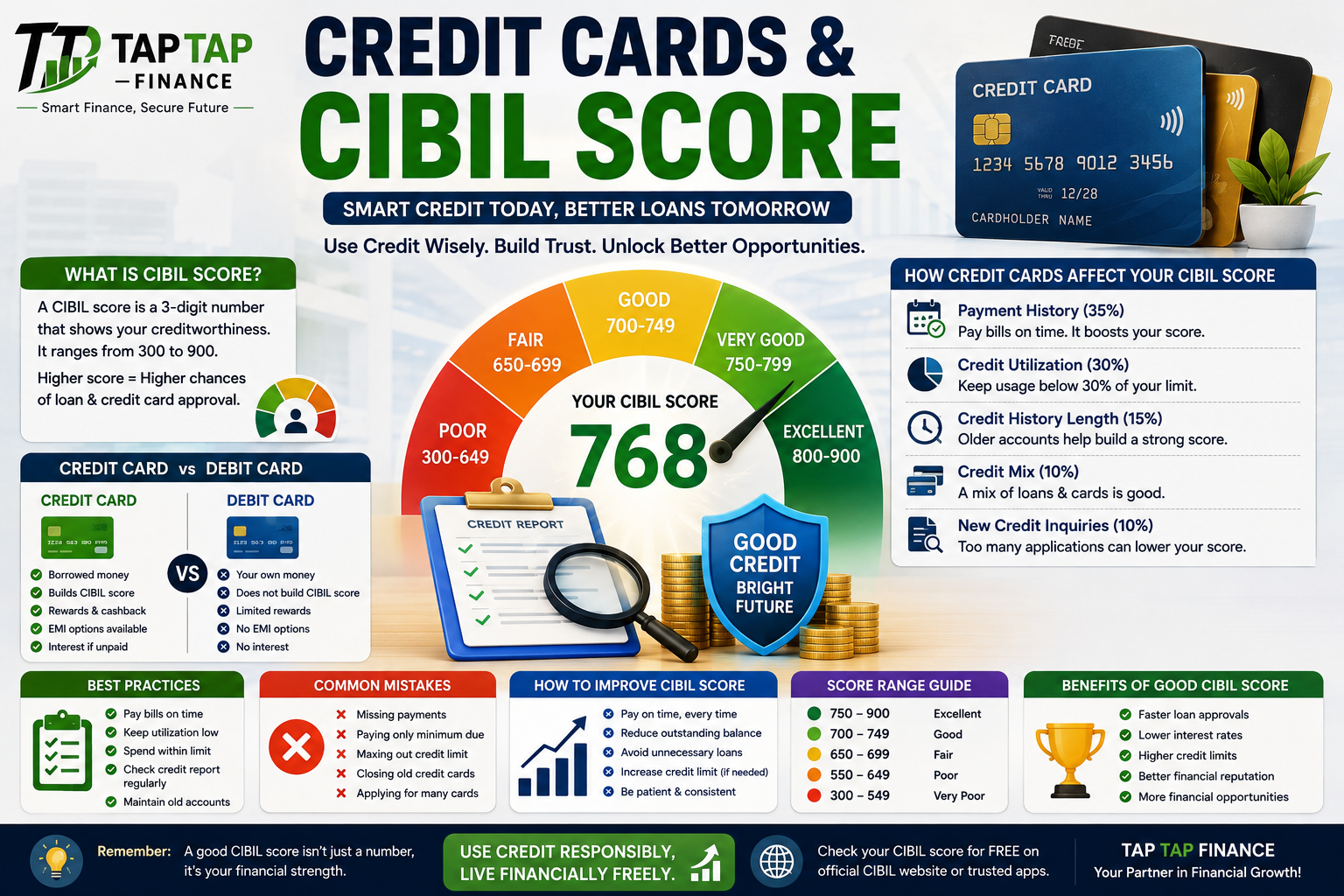
What Is a CIBIL Score?
A CIBIL score is a three-digit number that represents your creditworthiness. It is calculated based on your credit history and repayment behavior.
The score typically ranges from 300 to 900.
Generally, a higher score increases your chances of loan and credit card approval, although lenders consider other factors as well.
CIBIL Score Range
| CIBIL Score | Rating | What It Means |
|---|---|---|
| 750–900 | Excellent | Strong approval chances |
| 700–749 | Good | Good eligibility for many products |
| 650–699 | Fair | Approval possible with conditions |
| 550–649 | Poor | Limited borrowing options |
| Below 550 | Very Poor | Difficult to obtain new credit |
Why Is Your CIBIL Score Important?
Your CIBIL score affects many financial decisions.
A good score can help you:
- Get faster loan approvals
- Receive lower interest rates
- Qualify for higher loan amounts
- Increase your chances of premium credit card approval
- Improve your financial credibility
A poor score may lead to:
- Loan rejection
- Higher interest rates
- Lower credit limits
- Stricter eligibility requirements
How Credit Cards Affect Your CIBIL Score
Many people think owning a credit card lowers their credit score.
That’s a myth.
A credit card can improve your CIBIL score when used responsibly.
Here are the major factors that influence your score.
1. Payment History (Most Important)
Your payment history is one of the biggest factors affecting your CIBIL score.
Always:
- Pay the full bill before the due date
- Avoid missing EMI payments
- Set automatic payment reminders
Even one missed payment can negatively affect your score.
2. Credit Utilization Ratio
Credit utilization means how much of your available credit limit you’re using.
Example
Credit Limit: ₹1,00,000
Outstanding Balance: ₹25,000
Credit Utilization = 25%
Experts generally recommend keeping your utilization below 30%.
Lower utilization shows lenders that you manage credit responsibly.
3. Credit History Length
The longer your credit history, the better.
Avoid closing your oldest credit card unless there’s a strong reason to do so, as a longer history can positively influence your credit profile.
4. Credit Mix
Having different types of credit can strengthen your credit profile.
Examples include:
- Credit Cards
- Home Loans
- Car Loans
- Education Loans
- Personal Loans
A balanced mix demonstrates that you can manage different forms of credit responsibly.
5. New Credit Applications
Every time you apply for a loan or credit card, a lender may perform a hard inquiry on your credit report.
Too many applications within a short period can temporarily lower your score.
Apply only when you genuinely need credit.
Credit Cards vs Debit Cards
Many beginners confuse these two cards.
| Feature | Credit Card | Debit Card |
|---|---|---|
| Money Source | Borrowed from the bank | Your own bank balance |
| Builds CIBIL Score | Yes | No |
| Interest Charges | If dues are unpaid | None |
| Rewards | Often available | Limited |
| EMI Option | Usually available | Rare |
| Fraud Protection | Often stronger | Varies by bank |
Common Credit Card Mistakes That Hurt Your CIBIL Score
Paying Only the Minimum Due
Paying only the minimum due avoids late-payment penalties but leaves the remaining balance subject to interest, increasing your debt.
Always aim to pay the full outstanding amount whenever possible.
Missing Payment Deadlines
Late payments stay on your credit report and may affect your CIBIL score.
Use:
- Auto-debit
- Calendar reminders
- Banking app alerts
Maxing Out Your Credit Limit
Using nearly all of your credit limit can signal financial stress.
Try to keep your utilization below 30%.
Applying for Multiple Credit Cards
Each application may result in a hard inquiry.
Too many inquiries can reduce your credit score temporarily.
Closing Old Credit Cards
Closing an old card may shorten your average credit history and affect your overall available credit.
If the card has no significant annual fee and is managed responsibly, keeping it open may be beneficial.
How to Improve Your CIBIL Score Quickly
Pay Bills on Time
Consistency is key.
On-time payments help build a strong credit history.
Keep Credit Utilization Low
If your limit is ₹2,00,000, try not to use more than ₹60,000 at any given time.
Check Your Credit Report Regularly
Review your credit report for:
- Incorrect loan entries
- Wrong personal information
- Duplicate accounts
- Fraudulent activity
If you find errors, report them to the credit bureau or lender.
Avoid Unnecessary Loans
Only borrow when necessary.
Responsible borrowing improves financial health.
Increase Your Credit Limit (If Appropriate)
A higher credit limit—without increasing spending—can reduce your credit utilization ratio.
Example: How Good Credit Habits Improve Your Score
Meet Priya, a 28-year-old marketing professional.
She received her first credit card with a ₹50,000 limit.
Instead of using the full amount, she:
- Spent around ₹12,000–₹15,000 each month
- Paid the full bill before the due date
- Avoided unnecessary loan applications
- Checked her credit report annually
Over time, her credit profile strengthened, improving her chances of qualifying for better financial products.
Tips for First-Time Credit Card Users
- Choose a card that matches your needs.
- Pay the full bill every month.
- Track your spending regularly.
- Avoid impulse purchases.
- Keep your credit utilization low.
- Read the terms and conditions carefully.
- Use reward points wisely.
- Never share your card details or OTP with anyone.
Benefits of Having a Good CIBIL Score
A strong CIBIL score offers many advantages.
These include:
- Faster loan processing
- Better interest rates
- Higher credit limits
- Easier approval for premium credit cards
- Improved negotiating power with lenders
- Better financial reputation
Maintaining a good score can save money over the long term.
Credit Card Safety Tips
Protect yourself from fraud by following these best practices:
- Enable transaction alerts.
- Use secure websites for online payments.
- Never share CVV, PIN, or OTP.
- Lock your card immediately if it’s lost.
- Monitor transactions regularly.
Good security habits are just as important as good repayment habits.
Frequently Asked Questions (FAQs)
1. What is a good CIBIL score?
A score of 750 or above is generally considered good and may improve your chances of loan and credit card approval.
2. Can a credit card improve my CIBIL score?
Yes. Paying bills on time and maintaining low credit utilization can help improve your credit score over time.
3. Does checking my own CIBIL score reduce it?
No. Checking your own credit report is considered a soft inquiry and does not affect your credit score.
4. What is the ideal credit utilization ratio?
Many financial experts recommend keeping credit utilization below 30%.
5. Is paying only the minimum due enough?
No. While it avoids late-payment penalties, interest continues on the remaining balance. Paying the full amount is generally the better choice.
6. How long does it take to improve a CIBIL score?
The timeline varies depending on your credit history and repayment behavior. Consistent responsible credit use can gradually improve your score over several months.
7. Can I get a loan with a low CIBIL score?
It may still be possible, but approval may be harder and interest rates could be higher.
8. Should I have more than one credit card?
Multiple credit cards can be beneficial if managed responsibly. However, avoid applying for several cards in a short period and only keep cards you can manage effectively.
Final Thoughts
Your CIBIL score is one of the most important indicators of your financial health. A well-managed credit card is not just a payment tool—it can help you build a strong credit history, qualify for better loan offers, and access lower interest rates.
The secret is simple: pay on time, keep your credit utilization low, avoid unnecessary debt, and review your credit report regularly.
Whether you’re using your first credit card or already have several, disciplined credit habits today can create better financial opportunities tomorrow.
Start building your credit wisely today. Small, consistent financial habits can lead to a stronger CIBIL score and greater financial freedom in the future.