SIP vs FD: Which Investment Is Better for You?
If you’re new to investing, you’ve probably asked yourself, “Should I invest in a SIP or keep my money in a Fixed Deposit (FD)?” It’s one of the most common questions among beginners—and for good reason. Both options help you grow your money, but they work very differently.
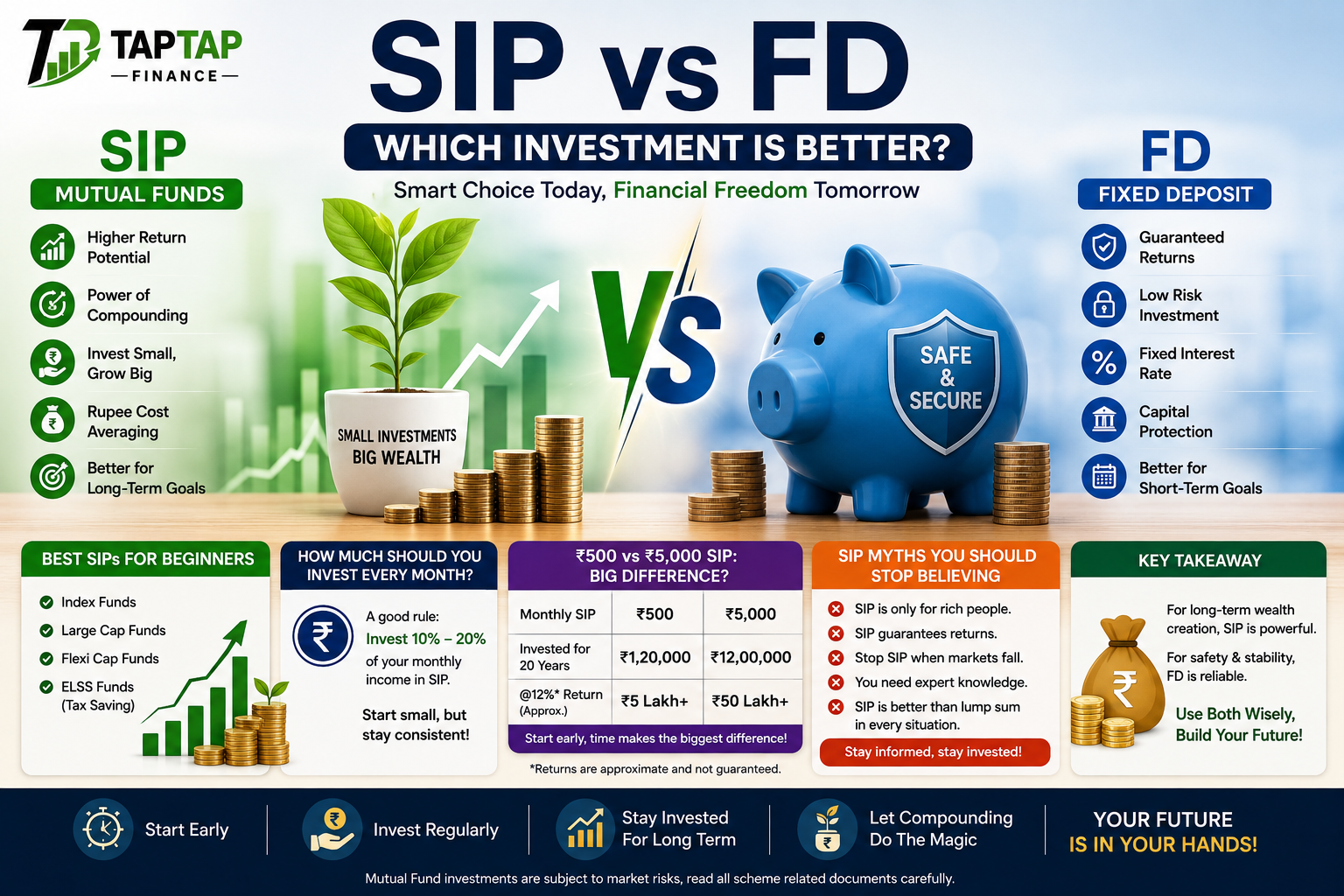
A Fixed Deposit offers stable, guaranteed returns, while a Systematic Investment Plan (SIP) gives you the opportunity to build long-term wealth through mutual funds. The right choice depends on your financial goals, risk tolerance, and investment horizon.
In this comprehensive guide, you’ll learn the differences between SIP and FD, the best SIPs for beginners, how much you should invest every month, common SIP myths, and whether investing ₹500 or ₹5,000 per month makes a significant difference.
What is SIP?
A Systematic Investment Plan (SIP) is a way of investing a fixed amount regularly in a mutual fund. Instead of investing a large amount at once, you invest monthly, weekly, or quarterly.
For example:
- ₹500 every month
- ₹2,000 every month
- ₹5,000 every month
Your money is invested in mutual funds managed by professional fund managers.
Benefits of SIP
- Start with as little as ₹500
- Disciplined investing
- Power of compounding
- Rupee Cost Averaging
- Flexible investment amount
- Suitable for long-term wealth creation
What is a Fixed Deposit (FD)?
A Fixed Deposit (FD) is a savings product offered by banks and financial institutions where you invest a lump sum for a fixed period and earn a predetermined interest rate.
The principal amount and interest are generally returned at maturity, making FDs a preferred option for conservative investors seeking predictable returns.
Benefits of FD
- Guaranteed returns
- Low risk
- Fixed interest rate
- Capital protection
- Suitable for short-term financial goals
SIP vs FD: Key Differences
| Feature | SIP | Fixed Deposit (FD) |
|---|---|---|
| Risk | Moderate to High | Very Low |
| Returns | Market-linked | Fixed |
| Average Long-Term Return | 10–15% (historically, depending on fund and market conditions) | Generally 6–8% (varies by bank and tenure) |
| Investment Method | Monthly or periodic | Usually Lump Sum |
| Liquidity | Depends on fund type | Limited before maturity (may incur penalties) |
| Inflation Protection | Better over the long term | May not always beat inflation |
| Best For | Wealth creation | Capital safety |
| Taxation | Depends on mutual fund type and holding period | Interest is taxable |
Who Should Choose SIP?
A SIP is ideal if you:
- Want long-term wealth creation
- Can tolerate market fluctuations
- Are investing for goals like retirement, education, or buying a home
- Want to benefit from compounding
Who Should Choose an FD?
An FD is suitable if you:
- Need guaranteed returns
- Prefer low-risk investments
- Are saving for short-term goals
- Want capital protection
Why SIP Can Be Better for Long-Term Goals
Historically, equity mutual funds have delivered higher long-term returns than traditional fixed deposits, although returns are not guaranteed and market performance can vary.
SIPs also help investors stay disciplined by investing regularly, regardless of market conditions.
For long-term goals of 10 years or more, SIPs have the potential to generate significantly higher wealth due to compounding.
Best SIPs for Beginners
If you’re starting your investment journey, choosing the right type of mutual fund is important.
1. Index Funds
Index funds track indices like the Nifty 50 or Sensex.
Why beginners like them:
- Lower expense ratio
- Broad market diversification
- Passive investing
- Easy to understand
2. Large-Cap Mutual Funds
Large-cap funds invest in established companies with a long track record.
Advantages:
- Lower volatility
- Suitable for first-time investors
- Long-term growth potential
3. Flexi-Cap Funds
These funds invest across large-cap, mid-cap, and small-cap companies.
Benefits:
- Diversification
- Professional management
- Flexibility across market segments
4. ELSS Funds
Equity Linked Savings Schemes (ELSS) provide tax benefits under applicable tax laws while offering exposure to equity markets.
Best for:
- Tax saving
- Long-term investing
How Much Should You Invest Every Month?
There is no one-size-fits-all answer. The right SIP amount depends on your income, expenses, goals, and risk tolerance.
A simple guideline:
| Monthly Income | Suggested SIP |
|---|---|
| ₹20,000 | ₹2,000–₹4,000 |
| ₹40,000 | ₹4,000–₹8,000 |
| ₹60,000 | ₹6,000–₹12,000 |
| ₹1,00,000 | ₹10,000–₹20,000 |
A common rule is to invest 10–20% of your monthly income if your budget allows.
The key is to start with an amount you can continue investing consistently.
₹500 vs ₹5,000 SIP: Is There a Big Difference?
Many beginners wonder if investing only ₹500 per month is worth it.
The answer is yes. Starting small is much better than not investing at all.
Example (Illustrative Only)
Assume an annual return of 12% over 20 years:
| Monthly SIP | Total Amount Invested | Approximate Value* |
|---|---|---|
| ₹500 | ₹1.2 lakh | Around ₹5 lakh |
| ₹5,000 | ₹12 lakh | Around ₹50 lakh |
*Illustrative figures only. Actual mutual fund returns are not guaranteed and may be higher or lower.
The important lesson is that time and consistency often matter more than starting with a large amount.
Common SIP Myths You Should Stop Believing
Myth 1: SIP Is Only for Rich People
False.
Many mutual funds allow you to start with ₹500 per month.
Myth 2: SIP Guarantees Returns
False.
SIPs invest in mutual funds, and returns depend on market performance. They are not guaranteed.
Myth 3: Stop SIP When Markets Fall
False.
Market corrections often allow investors to buy more units at lower prices through Rupee Cost Averaging.
Myth 4: You Need Expert Knowledge
False.
Beginners can start with diversified mutual funds and gradually learn more about investing.
Myth 5: SIP Is Better Than Lump Sum in Every Situation
Not always.
If you receive a large amount of money and market conditions suit your goals, a lump-sum investment may also be appropriate. The right choice depends on your circumstances.
Practical Tips for Successful SIP Investing
Set Clear Financial Goals
Decide whether you’re investing for:
- Retirement
- Child’s education
- Buying a house
- Emergency fund
- Financial independence
Stay Invested
Long-term investing generally provides better opportunities for compounding than frequently stopping and restarting investments.
Increase SIP Every Year
As your salary increases, try increasing your SIP amount by 10–15% annually.
This simple habit can make a meaningful difference over time.
Diversify Your Investments
Avoid putting all your money into one fund or one asset class.
Diversification helps manage risk.
Review Your Portfolio
Check your investments once or twice a year to ensure they still align with your financial goals.
Avoid reacting emotionally to short-term market movements.
SIP vs FD: Which One Should You Choose?
Here’s a quick decision guide:
Choose SIP if you want:
- Long-term wealth creation
- Better inflation-beating potential
- Higher growth potential
- Goal-based investing
Choose FD if you want:
- Guaranteed returns
- Low risk
- Short-term savings
- Capital protection
Many financial planners recommend using both. For example:
- Build an emergency fund with an FD or other low-risk savings.
- Invest long-term wealth-building money through SIPs.
This balanced approach can provide both stability and growth.
Frequently Asked Questions (FAQs)
1. Is SIP better than FD?
For long-term wealth creation, SIPs have the potential to outperform FDs because they invest in market-linked mutual funds. However, FDs provide guaranteed returns and lower risk.
2. Can I start a SIP with ₹500?
Yes. Many mutual funds allow investors to begin with ₹500 per month.
3. How much should I invest in SIP every month?
A common guideline is 10–20% of your monthly income, depending on your financial situation and goals.
4. Which SIP is best for beginners?
Index funds, large-cap funds, and flexi-cap funds are commonly chosen by beginners due to diversification and long-term growth potential.
5. Is SIP risky?
Yes. Since SIPs invest in mutual funds, returns are linked to market performance. Risk varies based on the type of mutual fund.
6. Should I stop my SIP during a market crash?
Generally, long-term investors continue their SIPs during market declines because regular investing can benefit from lower purchase prices. Consider your financial goals and consult a financial advisor if needed.
7. Can I invest in both SIP and FD?
Yes. Combining SIPs and FDs can help balance growth potential with capital safety.
8. Does increasing my SIP every year help?
Yes. Increasing your SIP as your income grows can significantly improve your long-term investment corpus.
Final Thoughts
When it comes to SIP vs FD, there is no universal winner. The right investment depends on your goals, time horizon, and comfort with risk.
If your objective is long-term wealth creation, a SIP can be a powerful way to benefit from disciplined investing and compounding. If your priority is capital protection and predictable returns, a Fixed Deposit may be more suitable.
For many people, the best strategy is not choosing one over the other—but using both wisely.
Remember, successful investing isn’t about finding the perfect product. It’s about starting early, staying consistent, and investing with a clear plan.
Ready to begin your investment journey? Start with an amount you can comfortably invest every month, review your progress regularly, and let time work in your favor.